Non-Toxic Water Bottles: Plastic-Free and Lead-Free Picks
What is the most non-toxic water bottle?An unlined 18/8 stainless steel or borosilicate glass bottle with a steel cap, so your water never touches plastic. If you want it insulated, pick one whose vacuum seal is made without lead.
Plastic is the material to avoid, and the cap matters most. When University of Copenhagen researchers left tap water in new reusable plastic sports bottles for 24 hours, more than 400 different substances moved from the plastic into the water (Tisler and Christensen, Journal of Hazardous Materials, 2022). In a separate study, the microplastic particles in plastic bottles came mainly from the cap and bottleneck grinding together as the bottle was opened and closed (Winkler et al., Water Research, 2019).
Most reusable bottles fall short at that cap. The body might be steel or glass, but the cap, straw, spout and gasket usually aren’t. Insulated bottles add a second question, after Stanley confirmed in 2024 that the seal at the base of its tumblers contains lead. The six picks below keep your drink against steel, glass or silicone, and we flag any plastic that’s left.
Key takeaways
- In plastic bottles, the cap and neck shed the most particles, and they shed more the longer the bottle is used.
- Most steel and glass bottles still ship with a polypropylene or Tritan lid. Check the underside of the cap.
- Many insulated bottles are sealed with a lead pellet covered by steel. Klean Kanteen, Owala and Pura say theirs are lead-free.
- Aluminum bottles need an inner liner, so they aren’t plain metal inside. Choose 18/8 stainless steel or borosilicate glass.
Best Non-Toxic Water Bottles at a Glance
 Klean Kanteen ReflectSteel, bamboo and silicone. No plastic, paint or coating.Check price on Amazon
Best insulated
Klean Kanteen ReflectSteel, bamboo and silicone. No plastic, paint or coating.Check price on Amazon
Best insulated Klean Kanteen Rise ReflectVacuum insulated with a lead-free seal and an all-steel interior.Check price on Amazon
Best all-steel cap
Klean Kanteen Rise ReflectVacuum insulated with a lead-free seal and an all-steel interior.Check price on Amazon
Best all-steel cap Klean Kanteen ClassicAdd the Steel Loop Cap and the whole thing goes in the dishwasher.Check price on Amazon
Best for kids
Klean Kanteen ClassicAdd the Steel Loop Cap and the whole thing goes in the dishwasher.Check price on Amazon
Best for kids Pura Sport MiniSteel and medical-grade silicone, including the sport top.Check price on Amazon
Best glass
Pura Sport MiniSteel and medical-grade silicone, including the sport top.Check price on Amazon
Best glass purifyou Glass BottleBorosilicate glass with a steel lid insert, in four sizes.Check price on Amazon
Best for coffee
purifyou Glass BottleBorosilicate glass with a steel lid insert, in four sizes.Check price on Amazon
Best for coffee Fellow Carter MoveA ceramic-lined travel mug you drink from with the lid off.Check price on Amazon
Non-Toxic Water Bottle Comparison
| Bottle | Best for | Body | Size | Insulated | What touches your drink | Plastic parts |
|---|---|---|---|---|---|---|
| Klean Kanteen Reflect | Everyday water, zero plastic | 18/8 stainless steel | 27 oz | No | Steel, silicone gasket | None |
| Klean Kanteen Rise Reflect | Cold water all day | 90% recycled 18/8 steel | 20 oz | Yes | Steel, silicone gasket | None |
| Klean Kanteen Classic + Steel Loop Cap | Dishwasher-safe, all steel | 18/8 stainless steel | Several sizes | No | Steel | None with the steel cap (stock cap is polypropylene) |
| Pura Sport Mini | Toddlers and kids | Stainless steel | 11 oz | No | Steel, silicone | None |
| purifyou Glass Bottle | Glass at home or the office | Borosilicate glass | 12 to 40 oz | No | Glass, steel lid insert, gasket | Lid shell |
| Fellow Carter Move | Hot coffee and tea | Steel, ceramic-coated inside | 12 oz | Yes | Ceramic coating, plus the lid when closed | Lid and splash guard |
On a phone, swipe the table sideways to see every column. Sizes and materials are from each manufacturer.
Do Plastic Water Bottles Shed Microplastics?
Yes, and reusing them doesn’t solve it. Three studies show where the plastic in a bottle ends up:
- Bottled water: Columbia researchers using a newer imaging method counted about 240,000 plastic particles per liter of bottled water, and roughly 90% were nanoplastics too small for earlier tests to see (Qian et al., PNAS, 2024).
- The cap: In the University of Milan cap study cited above, particle counts on caps and bottlenecks climbed with every round of opening and closing, and some cap brands wore down far faster than others.
- Reusable plastic sports bottles: Beyond the 400-plus substances from new bottles, the Copenhagen team detected more than 3,500 after a dishwasher cycle. Most came from the detergent, and some stayed in the water even after the bottles were rinsed, because detergent residue clung to the plastic more than it did to glass (Tisler and Christensen, 2022).
Plastic particles per liter of bottled water, about 90% of them nanoplastics too small for older tests to detect. PNAS, 2024
None of these studies measured health effects, and the Copenhagen team couldn’t name many of the substances they found. Still, the pattern lines up with what we see across kitchen plastics. Wear, heat and time all increase what plastic releases, and a water bottle gets daily wear for years. It’s also one of the easiest exposures to cut, because a steel or glass bottle does the same job.
A “BPA-free” label doesn’t change this. It tells you one chemical was left out of the recipe. Our consumer guide to BPA explains why the replacement bisphenols raise many of the same concerns.
Do Insulated Water Bottles Contain Lead?
Some do. Double-wall bottles keep drinks cold by pulling the air out from between the walls, and many manufacturers close that vacuum with a small solder pellet at the base. In early 2024, Stanley said its sealing material “includes some lead,” covered by a layer of stainless steel so it never touches you or your drink. The company said exposure would only be possible if the base were damaged (CNN via Gray News, 2024).
Stanley isn’t an outlier. YETI’s manufacturing FAQ describes the same kind of lead-containing sealing bead, fully encapsulated, and calls it common practice in the industry. Other brands have gone without it:
- Klean Kanteen says all of its products are lead-free and that it seals its vacuum bottles with silica and glass plugs, which it says cost six to seven times more (Klean Kanteen FAQ).
- Owala says its bottles have used lead-free solder from the beginning (Owala FAQ).
- Pura advertises its insulated bottles as having “no seal, no dot, no lead.”
An intact Stanley or YETI isn’t putting lead in your water. The risk is a bottle with a cracked or missing base cap, the kind of damage that comes from a few drops on concrete. If you’re buying new, a lead-free seal costs you nothing extra in daily use. If you already own one, check the bottom, and replace or warranty it if the base cap comes off.
What Makes a Water Bottle Non-Toxic?
Five checks cover almost every bottle on the shelf:
- The body material. 18/8 stainless steel (also sold as 304) or borosilicate glass. Both are inert enough for daily water and don’t need a liner.
- Whether it has a liner. Aluminum reacts with acidic drinks, so aluminum bottles are coated inside. SIGG admitted in 2009 that its liners contained BPA until August 2008 (Trailspace, 2009). Unlined steel or glass removes that question entirely.
- The underside of the cap. This is where most “plastic-free” bottles fall short. Look for a steel insert or an all-steel or bamboo-and-steel cap. A plastic cap with a steel body still puts plastic against your water every time you tip it back.
- Straws and spouts. Built-in straws and flip spouts are almost always plastic, and they’re hard to clean. Silicone spouts are the cleaner alternative. Our article on whether silicone leaches microplastics explains what to look for in food-grade silicone.
- The vacuum seal. For insulated bottles, look for a brand that states a lead-free seal in writing.
The Best Non-Toxic Water Bottles
Each pick was chosen on what the body and cap are made of, how an insulated body is sealed, and how it holds up in long-term owner reviews.

Most Plastic-Free: Klean Kanteen Reflect
The Klean Kanteen Reflect is made from three materials: stainless steel, bamboo and food-grade silicone. There’s no paint, no coating and no plastic on it. The bamboo top sits on a steel cap, so the inside of the bottle is steel from base to lid, and the only other thing your water touches is the silicone gasket. It’s a single-wall bottle, so it’s light and simple, but it won’t keep water cold for long.
- Size
- 27 oz (800 ml)
- Not steel
- Bamboo top, silicone gasket
- Insulated
- No
- Dishwasher
- Bottle yes, hand wash the cap
What we like
- No plastic anywhere on the bottle
- Unpainted, so nothing chips off
- Fits every Klean Kanteen Classic cap
Watch out for
- Not insulated
- Bamboo cap needs hand washing
- Klean Kanteen doesn’t recommend its steel caps for hot drinks

Best Insulated: Klean Kanteen Rise Reflect
If you want cold water all day without a plastic lid or a lead seal, the Klean Kanteen Rise Reflect is the one we’d pick. It uses the same steel, bamboo and silicone build as the Reflect, with a vacuum-insulated body made from certified 90% post-consumer recycled steel. Klean Kanteen rates the 20 oz size to keep drinks cold for up to 40 hours, and its vacuum is sealed with a silica and glass plug instead of lead solder.
- Size
- 20 oz (also 12 and 16 oz)
- Not steel
- Bamboo top, silicone gasket
- Keeps cold
- Up to 40 hours
- Lead
- Lead-free seal
What we like
- Insulated with no plastic in the lid
- Lead-free vacuum seal
- Fits a car cup holder
Watch out for
- Heavier than the single-wall Reflect
- Hand wash the bamboo cap
- Unscrewing a cap is slower than a flip lid

Best All-Steel Cap: Klean Kanteen Classic with the Steel Loop Cap
The Klean Kanteen Classic is an unlined 18/8 steel bottle that has been around for years. It ships with a polypropylene loop cap, so pair it with the Klean Kanteen Steel Loop Cap. That cap is solid 18/8 steel, threads included, so your water only touches steel. Unlike the bamboo caps, the whole setup can go in the dishwasher. The steel cap fits every Classic narrow-mouth bottle, so it also works on a Klean Kanteen you already own.
- Size
- Several sizes
- Not steel
- Nothing, with the steel cap
- Insulated
- No
- Dishwasher
- Yes, bottle and steel cap
What we like
- 100% steel inside with the steel cap
- Everything is dishwasher safe
- Cap upgrades older Klean Kanteens
Watch out for
- The steel cap is sold separately
- Not for hot drinks
- Dents if dropped
Already have a Classic? The Steel Loop Cap on its own is the cheapest upgrade in this guide.

Best for Kids: Pura Sport Mini
On most kids’ bottles, the lid is the biggest part, and it’s usually plastic. The Pura Sport Mini uses a stainless steel body with a sport top and sleeve made of medical-grade silicone, so there’s no plastic part for a kid to chew on. Pura says its bottles are certified by MADE SAFE, a nonprofit that screens products for known harmful chemicals. The top swaps out for Pura’s infant nipple or straw lids, so one bottle can follow a child from baby bottle to school.
- Size
- 11 oz (325 ml)
- Not steel
- Silicone top and sleeve
- Insulated
- No
- Dishwasher
- Yes
What we like
- No plastic, including the spout
- Silicone sleeve protects against drops
- Converts between sippy, straw and sport tops
Watch out for
- Small for older kids
- Silicone tops wear and need replacing
- Single wall, so drinks warm up
For older kids, the Pura Insulated 22 oz uses the same steel and silicone build and keeps water cold through a school day.

Best Glass Bottle: purifyou Borosilicate Glass Bottle
Glass is the most inert material in this guide. It doesn’t affect taste and it’s easy to see when it’s clean. The purifyou glass bottle is borosilicate glass in a silicone sleeve, with a stainless steel insert on the underside of the lid. The lid’s outer shell is plastic, but the insert is what faces your water. It comes in 12, 22, 32 and 40 oz, with time markers printed on the glass if you like tracking how much you drink.
- Size
- 12, 22, 32 or 40 oz
- Not glass
- Steel lid insert, plastic lid shell, gasket, silicone sleeve
- Insulated
- No
- Dishwasher
- Yes
What we like
- Glass body, steel where the lid meets your water
- Wide mouth for ice and cleaning
- Four sizes
Watch out for
- Heavier than steel, and it can break
- Not for carbonated drinks
- The lid shell is plastic

Best for Coffee on the Go: Fellow Carter Move
We couldn’t find an insulated travel mug with a plastic-free lid, so we looked for the next best design. The Fellow Carter Move has a ceramic-coated interior, so hot coffee sits against ceramic instead of bare steel. It’s built to drink from with the lid off. A thin rim and a removable splash guard replace the usual plastic sip hole. The lid is plastic, and it touches your coffee when the mug is closed and tipped. Fellow rates it at 12 hours hot and 24 hours cold.
- Size
- 12 oz (also 16 oz)
- Not steel
- Ceramic coating, plastic lid and splash guard
- Keeps hot
- Up to 12 hours
- Leak-proof
- Yes, lid closed
What we like
- Ceramic interior for hot drinks
- You drink from the rim instead of a plastic spout
- Leak-proof enough for a bag
Watch out for
- The lid is plastic
- Some owners report the ceramic coating chipping over time
- Pricier than a basic tumbler
Which Non-Toxic Water Bottle Should You Buy?
What About Stanley, Yeti, Owala and Hydro Flask?
All four make stainless steel bottles, and all four ship most of their bottles with plastic lids. Owala’s FreeSip spout and Stanley’s straw lids are plastic, and so are the standard Hydro Flask and YETI caps. So even with a steel body, your water passes plastic every time you take a drink.
If you already own one, you don’t need to throw it out. Three habits cut most of the plastic contact:
- Drink from the bottle instead of the straw when the lid allows it, and replace straws and spouts once they look scratched or cloudy.
- Keep hot drinks out of plastic-lidded bottles. Heat increases what plastic releases, and hot coffee sloshes against the lid.
- Check the base on Stanley and YETI drinkware, and stop using one if the bottom cap is cracked or missing.
Are Coffee Travel Mugs and Tumblers Safe?
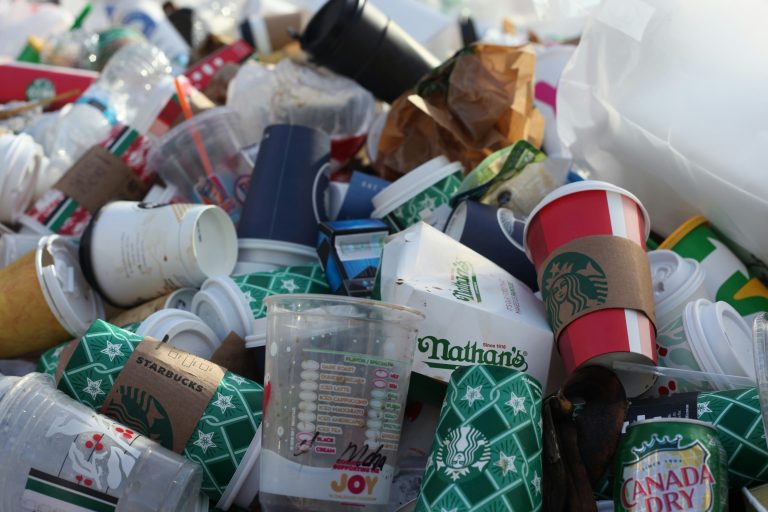
A travel mug beats a disposable cup by a wide margin. Paper coffee cups are lined with a thin plastic film, and Indian Institute of Technology researchers found that 15 minutes of 85 to 90°C water in one released about 25,000 micron-sized microplastic particles into a 100 ml serving (Ranjan et al., Journal of Hazardous Materials, 2021).
Reusable tumblers have their own weak spot. Nearly every insulated travel mug uses a plastic lid, and hot coffee is the worst case for plastic. We haven’t found a study that measures what a reusable plastic lid releases into coffee, so we can’t put a number on it. The practical moves are a ceramic-lined mug like the Fellow Carter Move, drinking with the lid off when you can, and not leaving coffee sitting against the lid for hours. If you brew at home, our guide to cutting microplastics from your morning coffee covers the brewer side.
Is Stainless Steel Safe for Drinking Water?
Yes, for water it’s one of the safest choices available. The research on stainless steel leaching is about cooking. A 2013 Oregon State study found nickel and chromium rose in tomato sauce simmered for hours in stainless steel, with brand-new steel leaching the most (Kamerud et al., Journal of Agricultural and Food Chemistry). Room-temperature water is a much gentler test than hours of hot, acidic sauce. If you fill your bottle with lemon water or juice often, or someone in your family has a nickel allergy, glass is the safer choice. Our stainless steel lunch box guide covers the same question for food.
What If You Want Filtered Water on the Go?
A non-toxic bottle keeps plastic out of your water after you fill it. It doesn’t clean up what’s already in the tap water. If you want both, our roundup of water filter bottles with the smallest plastic footprint compares bottles with a built-in filter, including Brita’s stainless steel model.
Frequently Asked Questions
What is the most non-toxic water bottle? An unlined 18/8 stainless steel or borosilicate glass bottle with a steel or bamboo-and-steel cap. The Klean Kanteen Reflect is the closest to zero plastic we found, since only steel and a silicone gasket touch your water.
Do Stanley cups have lead? Yes. Stanley says the pellet that seals the vacuum at the base contains some lead, covered by a stainless steel layer. It doesn’t touch your drink unless the base is damaged. If the bottom cap on your Stanley is cracked or missing, stop using it.
Which insulated water bottles are lead-free? Klean Kanteen, Owala and Pura all state that their insulated bottles are made without lead. YETI and Stanley say they use an encapsulated lead sealing bead.
Are glass water bottles safer than stainless steel? Glass is the most inert option and the better pick for acidic drinks or anyone with a nickel allergy. Steel is lighter, won’t break, and can be insulated. For plain water, both are good choices.
Are BPA-free plastic water bottles safe? BPA-free means one chemical was left out. Plastic bottles still shed particles from the cap, and new reusable plastic bottles released more than 400 substances into water within 24 hours in a 2022 study.
Do aluminum water bottles have plastic in them? Most do. Aluminum needs an inner coating to keep acidic drinks from reacting with the metal, and those liners are usually epoxy or another polymer. Unlined stainless steel avoids the issue.
Can you put hot drinks in a stainless steel water bottle? In an insulated bottle, yes. Klean Kanteen says its steel and bamboo caps aren’t meant for hot drinks, so use a cap rated for heat, or a travel mug built for coffee.
This article contains affiliate links. As an Amazon Associate, Plastic Free Everything earns from qualifying purchases at no extra cost to you.