The Great Non-Stick Deception: The 5 Best Pans to Eliminate Microplastics from Your Meals
You spend hours reading nutrition labels. You buy organic spinach. You invest in pasture-raised eggs to protect your family from unnecessary chemicals. And then you bring those beautiful, pristine ingredients home and sear them on a bed of degrading plastic polymers.
If you have ever stared at a scratched non-stick frying pan and wondered where those missing flakes of black coating actually went, you already know the answer. You ate them.
For decades, we were told that traditional non-stick coatings were perfectly safe unless you overheated them to extreme temperatures. Recent 2025 and 2026 data has completely dismantled that myth. Research from the Global Plastics Treaty coalition and independent consumer safety groups shows that a single surface scratch on a standard polytetrafluoroethylene (PTFE) coated pan can release over 9,000 microplastic particles into your food during one cooking session.
The industry responded to consumer outrage with a massive greenwashing campaign. They stamped PFOA-Free on their packaging in bold green letters. It sounds incredibly safe. But PFOA is just one chemical in a massive family of thousands of forever chemicals known as PFAS. To keep the pans slippery, manufacturers simply swapped the banned PFOA for other highly toxic, under-regulated synthetic polymers.
If you want to protect your endocrine system and eliminate microplastics from your meals, the solution is not a better synthetic plastic coating. The solution is returning to raw, inert, elemental materials.
By switching to truly plastic-free skillets made of steel, iron, or pure ceramic, you are taking the single most effective step toward a non-toxic kitchen. Yes, there is a slight learning curve. But the reward is food that actually tastes like food, cooked in pans that will literally last a lifetime.
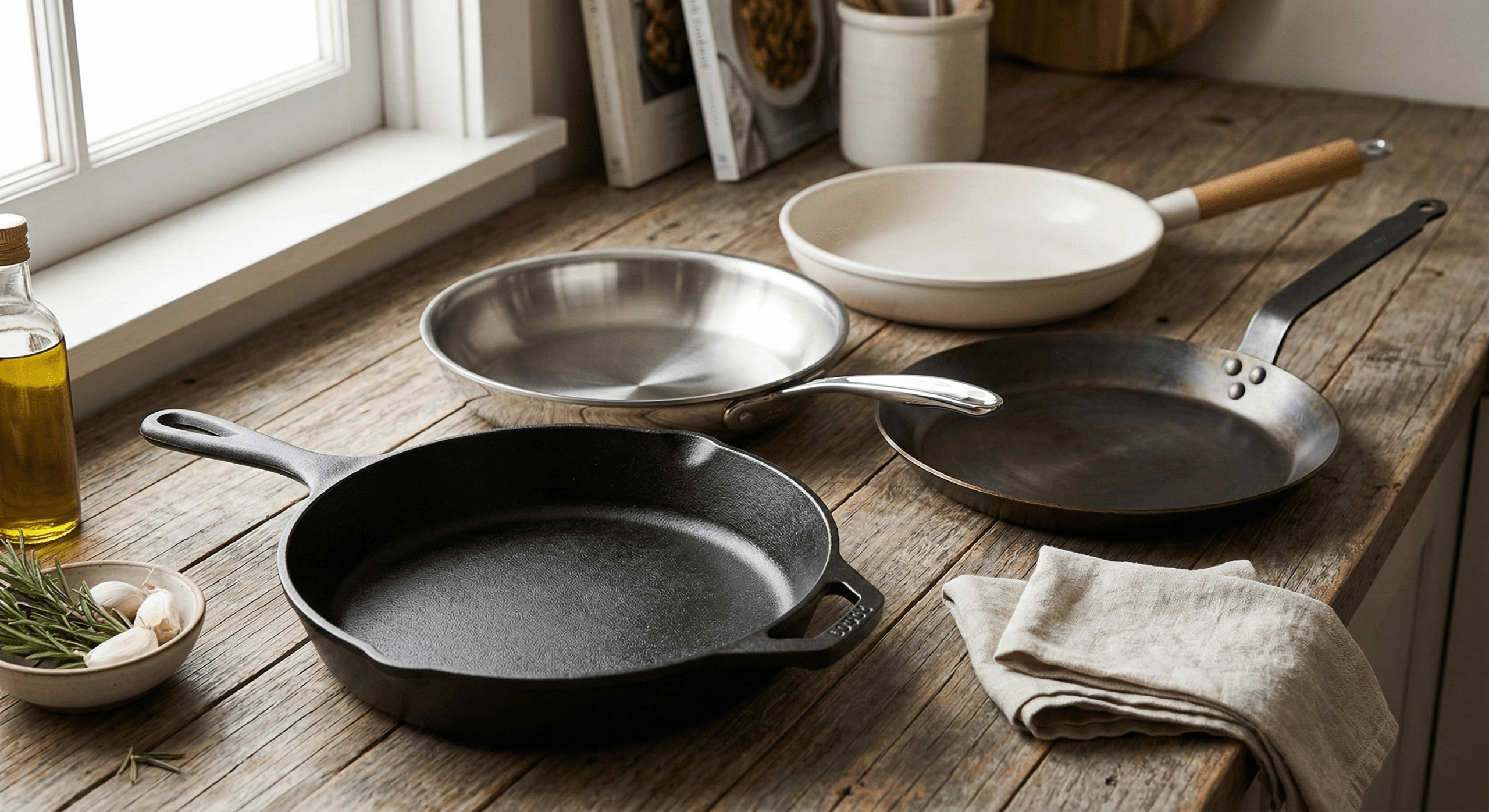
Our Top 5 Plastic-Free Pans
Quick Takeaways
| Brand | Material | Category | Pros | Cons |
| Made In Stainless Clad Pan | 5-Ply Stainless Steel | Best Overall | • Indestructible and warp-resistant • Zero coatings to scratch or degrade • Exceptional heat control | • Requires proper heat management to prevent sticking • Can discolor over time |
| Lodge Cast Iron Skillet | Uncoated Cast Iron | Budget Pick | • Extremely affordable • Naturally non-stick when seasoned • Fortifies food with dietary iron | • Very heavy • Requires regular seasoning and immediate drying to prevent rust |
| Xtrema Versa Skillet | 100% Pure Ceramic | Investment Pick | • Absolutely zero metal or chemical coatings • Non-reactive to acidic foods • Microwave and dishwasher safe | • Slow to heat up • Can shatter if dropped on a hard surface |
| Caraway Ceramic Pan | Mineral Ceramic over Aluminum | Best Transition Pick | • True non-stick feel without PFAS • Beautiful design and colors • Very easy to wipe clean | • Ceramic coating degrades over a few years • Must not be used on high heat |
| Misen Carbon Steel Pan | Carbon Steel | The Chef’s Pick | • Lighter and more maneuverable than cast iron • Builds a brilliant non-stick patina • Handles blistering high heat | • Cannot be put in the dishwasher • Acidic foods will strip the seasoning |
How We Chose the Best Plastic-Free Pans
We evaluated dozens of skillets based on criteria that matter most to conscious consumers trying to reduce toxic loads without sacrificing culinary performance.
- Absolute Material Purity: The cooking surface must be entirely free of PTFE, PFOA, and all other PFAS forever chemicals. We rejected any hybrid pans that hide polymer coatings beneath metal grids.
- Microplastic Elimination: The pan must not shed synthetic particles under high heat, friction from metal spatulas, or aggressive washing.
- Longevity and Durability: We prioritized materials that get better with age. A true eco-friendly kitchen product is one you only have to buy once.
- Real-World Usability: A safe pan is useless if everything burns to the bottom of it. We looked for materials that offer natural or safe non-stick properties when used correctly.
The Best Plastic-Free Pans
Here are our top recommendations categorized by budget, performance, and lifestyle needs.
1. Best Overall: Made In Stainless Clad Frying Pan
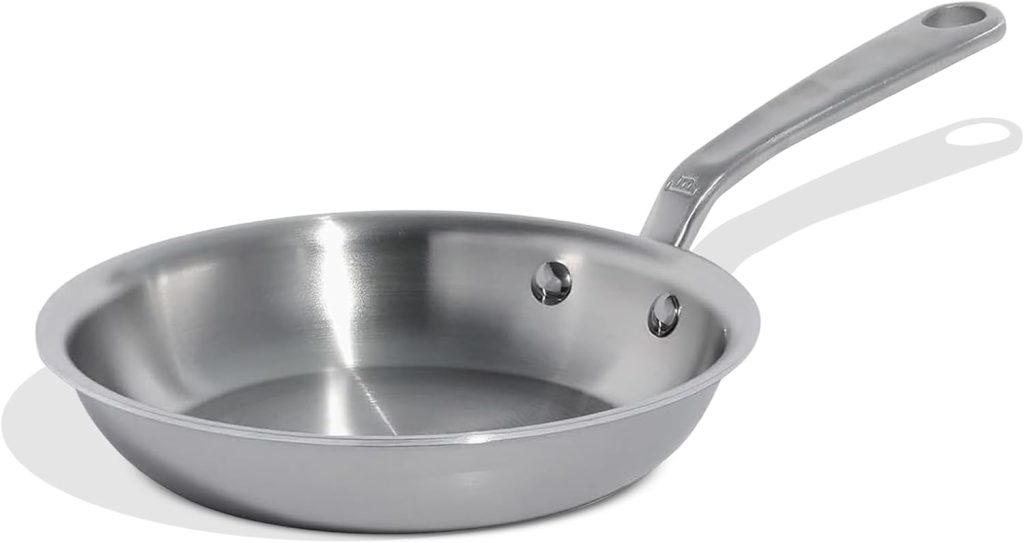
If you walk into the kitchen of a Michelin-star restaurant, you will not see cheap non-stick pans. You will see a wall of gleaming stainless steel. The Made In Stainless Clad Frying Pan brings that professional-grade purity into the home kitchen.
Constructed in Italy from premium 5-ply metal (alternating layers of stainless steel and heat-conductive aluminum), this pan is entirely free of chemical coatings. The food touches nothing but 304-grade stainless steel. It heats evenly, holds its temperature beautifully, and produces a perfect golden sear on proteins. It is completely safe to use with metal utensils. You can confidently scrape the bottom with a steel spatula without fearing a cloud of microplastics.
Pros
- 100 percent free of PFAS and synthetic polymers.
- Incredibly durable 5-ply construction resists warping.
- Oven-safe up to 800 degrees Fahrenheit.
- Metal utensil safe.
Cons
- There is a learning curve. You must preheat the pan properly before adding oil to create a temporary non-stick barrier.
- Not ideal for delicate items like scrambled eggs until you master temperature control.
2. The Budget Pick: Lodge 10.25-Inch Cast Iron Skillet
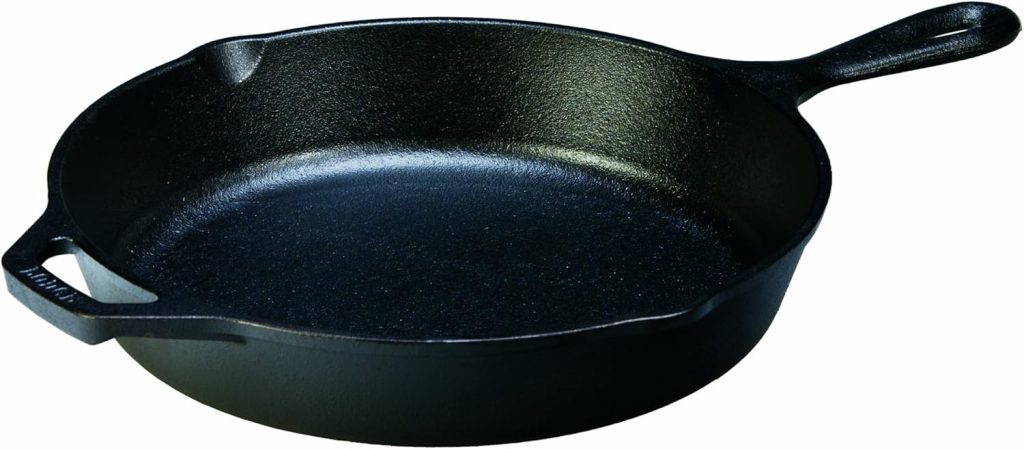
You do not need to spend hundreds of dollars to detoxify your kitchen. The Lodge Cast Iron Skillet has been an American kitchen staple for over a century for a very good reason. It is virtually indestructible and costs less than a week of gourmet coffee.
Cast iron is naturally non-toxic. Its non-stick properties come from a process called “seasoning,” where natural cooking oils are baked into the pores of the iron to create a slick, polymerized surface. This is entirely natural and safe. As a bonus, cooking in raw cast iron actually fortifies your meals with small amounts of dietary iron. It is the ultimate heavy-duty workhorse for searing steaks, baking cornbread, and frying potatoes.
Pros
- Unbeatable price point for lifetime durability.
- Develops a phenomenal, totally natural non-stick surface over time.
- Can be used on any cooktop, in the oven, or directly over a campfire.
- Adds trace amounts of beneficial iron to your diet.
Cons
- It is incredibly heavy and can be difficult to maneuver with one hand.
- Requires specific maintenance. It must be hand-washed and dried immediately to prevent rust.
3. The Investment Pick: Xtrema 10-Inch Versa Skillet
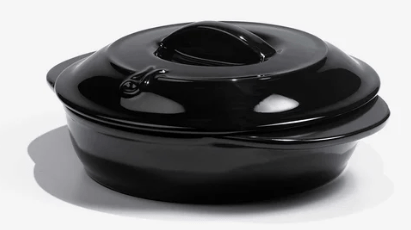
If your primary concern is absolute material purity, Xtrema is in a class of its own. While many brands offer a metal pan with a ceramic coating painted on top, Xtrema pans are constructed entirely from 100 percent pure, solid ceramic.
There is no metal core. There are no synthetic glazes. This means there is zero risk of heavy metal leaching or chemical off-gassing, no matter how hot the pan gets. The Versa Skillet is incredibly versatile. Because it contains no metal, it is one of the only stovetop pans in the world that is also completely safe to use in the microwave. It is completely non-reactive, making it the perfect vessel for simmering highly acidic tomato sauces that might pit or degrade metal pans.
Pros
- The purest cooking surface available with zero metal or plastics.
- Third-party tested to be free of lead, cadmium, and all PFAS.
- Safe for the stovetop, oven, broiler, microwave, and dishwasher.
- Never leaches metallic flavors into acidic foods.
Cons
- It is fragile. If you drop it on a tile floor, it will likely shatter.
- Ceramic is a slow heat conductor. It takes significantly longer to preheat than steel or iron.
4. The Transition Pick: Caraway Ceramic Frying Pan
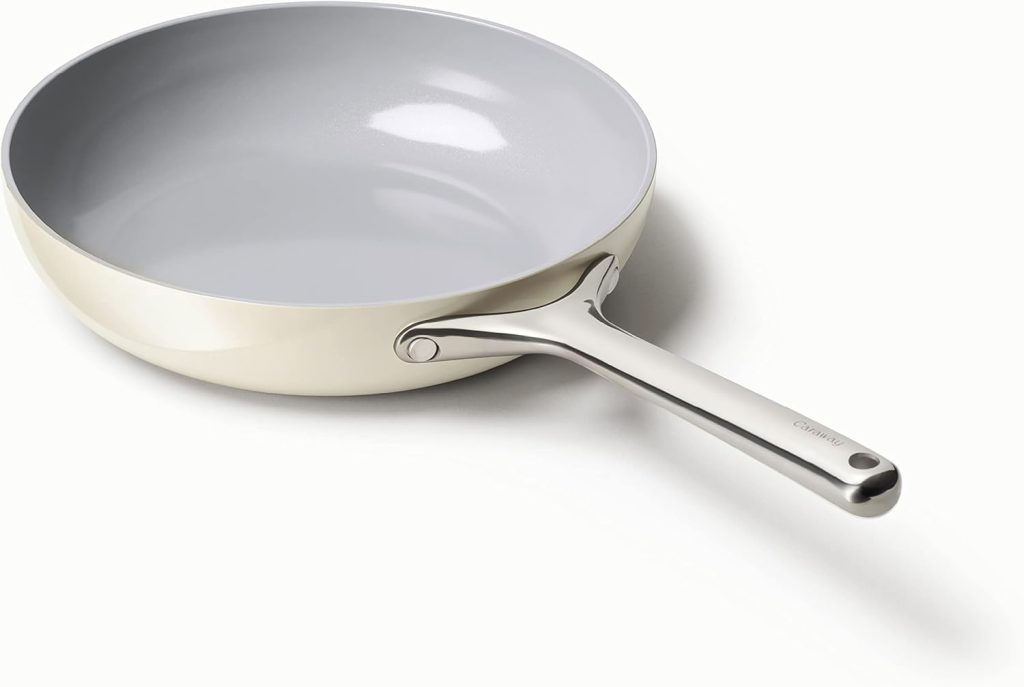
If you are accustomed to the effortless, slippery convenience of Teflon and find the idea of cast iron intimidating, Caraway offers the best bridge into safe cooking.
Caraway pans utilize an aluminum core for rapid heating, but the food surface is coated in a mineral-based sol-gel ceramic. This coating is derived from silica (sand) rather than carbon-based petroleum plastics. It provides a phenomenal non-stick experience that allows eggs to slide right out of the pan without the use of toxic forever chemicals. It is sleek, comes in beautiful modern colors, and cleans up with just a gentle wipe of a soapy sponge.
Pros
- Provides a traditional non-stick experience without PTFE or PFAS.
- Aesthetic, design-forward appearance.
- Requires very little cooking oil.
- Lightweight and easy to handle.
Cons
- The ceramic coating is less durable than raw steel. It will slowly degrade over a few years and lose its non-stick properties.
- Must be kept strictly on low to medium heat to protect the coating.
5. The Chef’s Pick: Misen Carbon Steel Pan
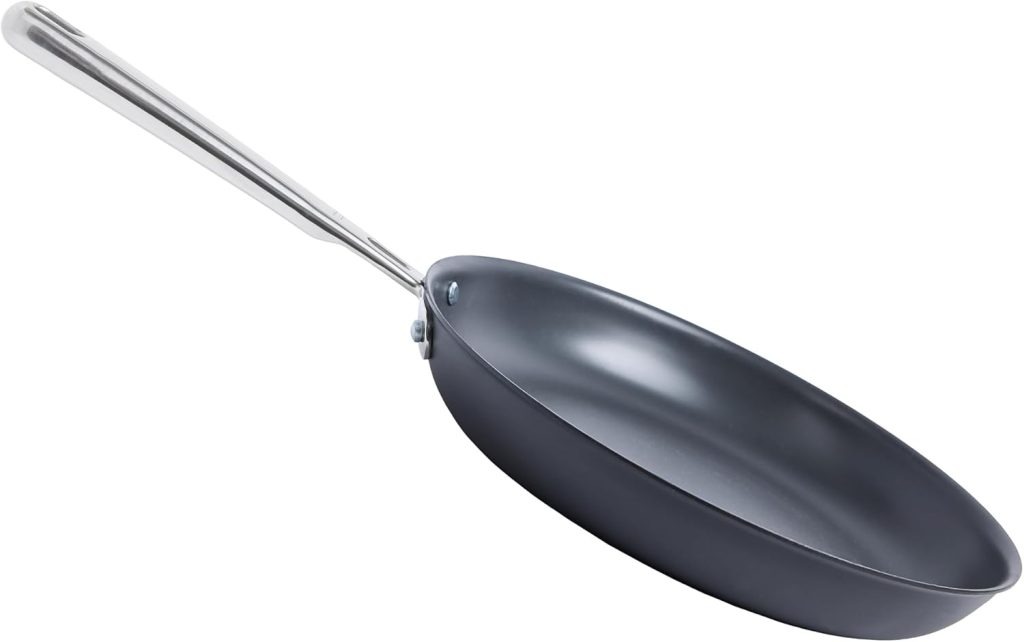
Carbon steel is the culinary world’s best-kept secret. It behaves like a hybrid between cast iron and stainless steel. It offers the extreme heat tolerance and natural seasoning properties of cast iron, but with a much thinner, lighter, and more responsive profile.
The Misen Carbon Steel Pan arrives unseasoned (or pre-seasoned with a light layer of wax). Once you build up a layer of polymerized oil, it becomes incredibly slick. It is the perfect pan for aggressively searing fish skin to a crisp without the fish sticking to the bottom. Because it is highly responsive to heat changes, you have much more granular control over your cooking temperature than you do with a thick slab of cast iron.
Pros
- Naturally non-stick once properly seasoned.
- Much lighter and easier to toss ingredients than cast iron.
- Handles extreme restaurant-level high heat perfectly.
- Zero synthetic chemicals or coatings.
Cons
- Highly reactive to acidic foods. Cooking tomatoes or lemon juice will strip the hard-earned seasoning.
- Requires regular maintenance and cannot be put in the dishwasher.
Evaluating Materials for Plastic-Free Cooking
When you strip away the deceptive marketing of the cookware industry, you realize that true safety comes from understanding raw materials. If you want a plastic-free kitchen, you must learn to cook on surfaces that come from the earth, not a laboratory.
Stainless Steel (The Reliable Workhorse)
High-quality stainless steel is an alloy made primarily of iron, chromium, and nickel. The chromium creates an invisible, self-healing oxide layer that prevents the iron from rusting. This makes the surface entirely inert and safe for food contact. It will not degrade, it will not shed microplastics, and it will not leach harmful chemicals under normal cooking conditions. The trick to cooking with stainless steel is temperature control. You must heat the empty pan until a drop of water dances across the surface like a bead of mercury. Only then do you add your oil and food. This creates a thermal barrier that prevents sticking.
Cast Iron and Carbon Steel (The Natural Non-Stick)
Both of these materials rely on the science of polymerized oils. When you heat unsaturated fats (like grapeseed or canola oil) past their smoke point on raw iron or steel, the fat molecules break down and reform into a hard, plastic-like crust. But unlike synthetic Teflon, this crust is made entirely of carbon. It is completely natural, non-toxic, and creates a highly effective non-stick surface. If you happen to scrape a tiny bit of this seasoning into your food, you are just eating a microscopic speck of carbonized cooking oil.
Pure Ceramic vs. Ceramic Coatings
It is vital to understand the difference here. Ceramic coatings (like Caraway) use a thin layer of silica-based gel sprayed over a metal pan. These are vastly safer than PTFE plastics and represent a massive step forward. However, they are still a coating, and they will eventually wear out after a few years of daily use.
Pure ceramic (like Xtrema) is made of clay and water baked at extreme temperatures. It is solid all the way through. It is the most chemically stable and unreactive cooking surface on the planet. It will never wear out, though it requires gentle handling to prevent physical breakage.
FAQs About Plastic-Free Pans
Is PFOA-Free the same as plastic-free? No. PFOA is just one specific chemical in the PFAS family. When a pan says PFOA-Free, it almost always means the manufacturer simply used a different synthetic plastic coating like PTFE (Teflon) or GenX. These are still plastics and still pose health risks.
Does stainless steel leach heavy metals? High-quality 304 or 316 grade stainless steel is highly stable. While it can leach trace amounts of nickel and chromium if you boil highly acidic foods (like tomato sauce) for many hours, it is generally considered one of the safest and most inert cooking surfaces available for daily use.
Are ceramic coated pans completely safe? Yes, high-quality ceramic coatings made from silica (sand) are free of PFAS forever chemicals and do not shed microplastics. However, they do have a limited lifespan and will eventually lose their non-stick properties if exposed to high heat or metal utensils.
How do I stop eggs from sticking to stainless steel? Heat your dry stainless pan on medium heat until a drop of water rolls around the surface like a marble without evaporating. Then wipe out the water, add your butter or oil, and immediately add your eggs.
Can I use soap on my cast iron pan? Yes. Modern dish soaps are quite gentle and do not contain the harsh lye that used to strip seasoning from cast iron decades ago. A quick wash with mild soap and a sponge is perfectly fine, as long as you dry the pan completely right away.
What are the signs my non-stick pan is toxic? If your traditional non-stick pan has any visible scratches, peeling, or flaking, it is actively shedding plastic polymers into your food. Furthermore, if you heat a dry pan above 500 degrees Fahrenheit, the chemical coating begins to invisibly off-gas toxic fumes.
Why is carbon steel better than cast iron? It isn’t necessarily better, just different. Carbon steel is thinner, significantly lighter, and responds to temperature changes much faster than cast iron. It is preferred by professional chefs for sautéing and tossing ingredients, while cast iron is better for heat retention and baking.
Are hybrid pans with stainless steel patterns safe? Most hybrid pans feature a raised stainless steel honeycomb pattern with a traditional non-stick coating recessed underneath. If that recessed coating is made of PTFE, it is still a plastic-coated pan and carries the same microplastic shedding risks over time.
Can I put my ceramic-coated pan in the dishwasher? You should never put a ceramic-coated pan in the dishwasher. The harsh alkaline detergents and prolonged high heat will rapidly degrade the silica coating, ruining the non-stick properties within a few months. Always hand wash them.
Do I really need to season my cast iron pan if it comes pre-seasoned? Factory pre-seasoning gives you a great head start and prevents the pan from rusting in transit. However, you will get the best non-stick results by applying your own thin layers of oil and baking it at home to build a stronger, thicker patina over time.
This article contains affiliate links. As an Amazon Associate, Plastic Free Everything earns from qualifying purchases at no extra cost to you.