The Toxic Truth About Your Garden Hose (And The Safest Non-Toxic Alternatives)
That standard green vinyl hose baking in your summer lawn is leaching lead stabilizers, endocrine-disrupting phthalates, and synthetic microplastics directly into your organic heirloom tomatoes every time you turn on the spigot.
I spent the last couple of years handling residential construction cleanup and seasonal lawn care at a property in Colorado. The high-altitude summer sun out there is absolutely unforgiving. You learn very quickly what materials can survive the elements and what rapidly breaks down. A cheap plastic hose left on the grass in July does not just get physically hot. It turns into an active chemical soup dispenser.
We spend small fortunes on organic seeds, premium compost, and raised cedar beds to avoid industrial chemicals. Then, we unknowingly blast our fragile seedlings with water steeped in synthetic plasticizers. It makes zero sense.
The good news is that you do not have to compromise your health to keep your garden alive. You just need to know exactly how to read the labels. We are breaking down the polymer science behind the “baking hose” effect, exposing the regulatory loopholes that allow brands to greenwash cheap plastic, and highlighting the materials that are actually safe for your soil.
What Exactly Is Leaching From Your Standard PVC Garden Hose?
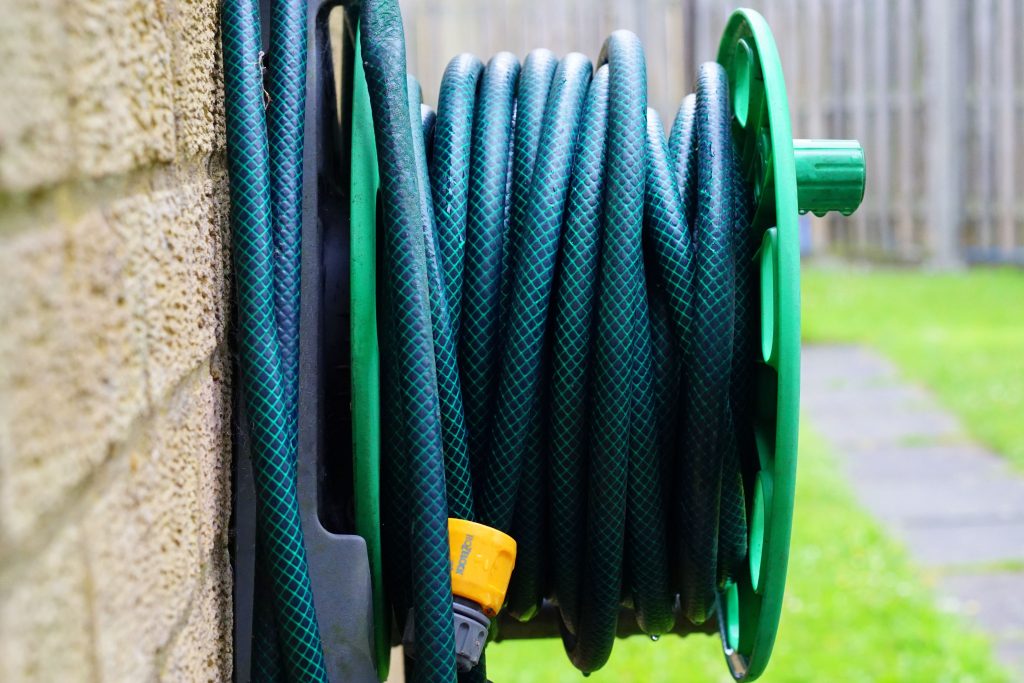
If you walk into any massive home improvement store, ninety percent of the garden hoses on the shelf are made from Polyvinyl Chloride (PVC).
PVC is naturally a hard, brittle plastic. To make it flexible enough to coil around a reel, manufacturers must pump it full of chemical plasticizers. These plasticizers can make up to thirty percent of the hose by weight. The problem lies in the chemistry.
The Phthalate Migration Problem
The most common plasticizers used in cheap vinyl hoses are phthalates. Phthalates are known endocrine disruptors. They interfere with human hormones and have been linked to reproductive issues.
Here is the critical scientific flaw: Phthalates do not chemically bond to the PVC polymer matrix. They merely sit between the plastic molecules to keep them spaced apart. Because they are not locked into the material, they are free to migrate. When water sits inside a PVC hose, the phthalates continuously leach into the liquid.
Heavy Metal Stabilizers
UV radiation and heat rapidly degrade PVC. To prevent the hose from cracking and crumbling after a single season in the sun, manufacturers add chemical stabilizers. Historically, the most common stabilizer has been lead.
While domestic manufacturing has improved, independent testing by organizations like the Ecology Center has repeatedly found elevated levels of lead, cadmium, and organotin compounds in standing hose water. When you take a sip from a sun-baked hose, you are ingesting a concentrated dose of these heavy metals.
The Microplastic Shedding Reality
As the outer layers of the vinyl photodegrade from UV exposure, the hose begins to chalk and shed. This process releases thousands of microplastic particles into the water stream.
Recent soil biology studies confirm that microplastic accumulation in garden beds is not harmless. These synthetic fragments alter soil bulk density. They disrupt water retention. Even worse, earthworms ingest these microplastics, which damages their digestive tracts and degrades the overall health of your soil biome.
The “Drinking Water Safe” Loophole: How Brands Greenwash PVC
You might assume that buying a hose labeled “Drinking Water Safe” solves the problem. Unfortunately, consumer protection laws are full of massive loopholes. Brands know exactly how to exploit them.
The Flawed NSF/ANSI 61 Testing Standard
When a hose claims to be safe for drinking water, it usually means it has passed NSF/ANSI 61 testing. This is a standard designed for municipal water pipes.
The test evaluates water flowing rapidly through a pipe under controlled, ambient laboratory conditions. The water is usually around 73 degrees Fahrenheit. The standard does not test what happens when water sits stagnant in a dark green tube baking on a 90-degree lawn for three days.
Heat accelerates chemical leaching exponentially. A hose that passes a flow test in an air-conditioned laboratory will still dump a toxic load of plasticizers into your garden when exposed to real-world summer conditions.
The “BPA-Free” Distraction
Garden brands love to slap a giant “BPA-Free” sticker on their packaging. Do not let this fool you.
Bisphenol A (BPA) is a chemical used to harden clear plastics like polycarbonate. It is almost never used in flexible vinyl hoses anyway. Brands use the BPA-Free label as a marketing distraction. They want you to feel secure so you stop asking questions about the phthalates, vinyl chloride monomers, and heavy metals that are actually inside the product.
The Reality of “Lead-Free” Brass and Aluminum Fittings
The hardware on the ends of your hose matters just as much as the flexible tubing itself. Cheap brass fittings are notoriously contaminated with lead added during the casting process to improve machineability.
Under the Safe Drinking Water Act, fixtures and couplings can legally be labeled “lead-free” even if the wetted surface contains up to 0.25 percent lead by weight. Uncoated brass fittings left sitting in standing water can still leach detectable lead levels into your initial spray.
Even worse are aluminum fittings. If you attach an aluminum hose coupling to a standard brass spigot on your house, you set off galvanic corrosion. Because aluminum and copper alloys have different electrode potentials, the metals react in the presence of water and minerals. They chemically weld together, forcing you to cut the hose off your outdoor faucet with a hacksaw.
The Stainless Steel Myth: Why Metal Hoses Are Not PVC-Free
In recent years, lightweight stainless steel garden hoses have exploded in popularity. They are marketed as indestructible, kink-proof, and eco-friendly alternatives to vinyl. Marketers play into the assumption that because the exterior is shiny 304 stainless steel, the hose is completely plastic-free.
This is one of the most pervasive greenwashing traps in the gardening industry.
What Is Hidden Inside Stainless Steel Hoses?
A metal garden hose is not a solid steel pipe. It is an interlocking flexible metal armor shell wrapped around an inner flexible tube. The steel shell provides mechanical protection against punctures and dogs, but it cannot hold water pressure on its own.
When you investigate the specifications of commercially available stainless steel hoses, you discover a troubling reality: virtually every option on the market hides an inner core made of flexible PVC or cheap synthetic vinyl.
Because manufacturers assume the metal casing shields the inner tube from direct UV exposure, they often use low-grade PVC formulations packed with volatile plasticizers. Water sitting inside a sun-heated metal hose still comes into direct contact with vinyl polymers. The steel exterior absorbs heat rapidly, turning the interior into a miniature greenhouse that accelerates plasticizer migration.
Aluminum Fittings and Cheap Hardware
To keep manufacturing costs low, almost all readily available stainless steel hoses utilize stamped aluminum fittings or low-grade nickel-plated zinc connectors. As established, aluminum couplings screwed onto outdoor brass faucets trigger galvanic corrosion within months.
At this moment, I have found no readily available, widely distributed stainless steel garden hoses on the market that combine a verified 100 percent PVC-free inner lining (such as food-grade polyurethane or solid natural latex) with heavy-duty lead-free brass fittings. Until manufacturers produce a metal hose with a food-grade polyurethane lining and solid brass hardware, stainless steel hoses remain a greenwashed compromise.
Material Teardown: What Materials Are Actually Non-Toxic?
To build a truly chemical-free watering setup for your organic crops, you must eliminate PVC entirely. There are two primary non-toxic materials that meet strict safety standards: Food-Grade Polyurethane and 100% EPDM or Natural Rubber.
1. Food-Grade Polyurethane (PU)
Polyurethane is an advanced synthetic elastomer that provides incredible flexibility without requiring plasticizers.
- The Chemistry: Polyether-based polyurethane is the gold standard for clean liquid transfer. It is chemically inert and does not contain phthalates, vinyl chloride, or heavy metal stabilizers. It will not leach synthetic chemicals into standing water even under summer heat.
- Durability and Weight: Polyurethane is remarkably lightweight, making it roughly half the weight of traditional rubber hoses. It features high abrasion resistance and outstanding tensile strength.
- Kink Resistance: High-grade polyurethane hoses feature thick, engineered walls that resist kinking while maintaining light flexibility.
2. 100% EPDM Rubber (Ethylene Propylene Diene Monomer)
Commercial-grade EPDM rubber is the historic, heavy-duty standard for organic farms, commercial nurseries, and serious growers.
- The Chemistry: EPDM is a synthetic rubber compound engineered for extreme weather and chemical resistance. It contains zero PVC, zero phthalates, and zero heavy metal stabilizers. It does not leach toxins into water.
- Thermal Performance: EPDM rubber offers unparalleled temperature tolerance. It remains supple and flexible at sub-zero temperatures (down to -40 degrees Fahrenheit) and will not soften or degrade in boiling heat up to 160 degrees Fahrenheit.
- Durability and Weight: EPDM rubber hoses are built like tank treads. They can handle high burst pressure (often exceeding 400 PSI) and survive being run over by trucks. The trade-off is weight. Rubber is heavy and requires physical effort to haul across large yards.
The Best Non-Toxic Garden Hoses of 2026
We evaluated dozens of watering products against strict material criteria: zero PVC, zero phthalate plasticizers, zero lead-leaching hardware, and zero aluminum couplings. These three options represent the safest, most durable non-toxic garden hoses available.
Budget: Water Right 400 Series Polyurethane Coil Hose
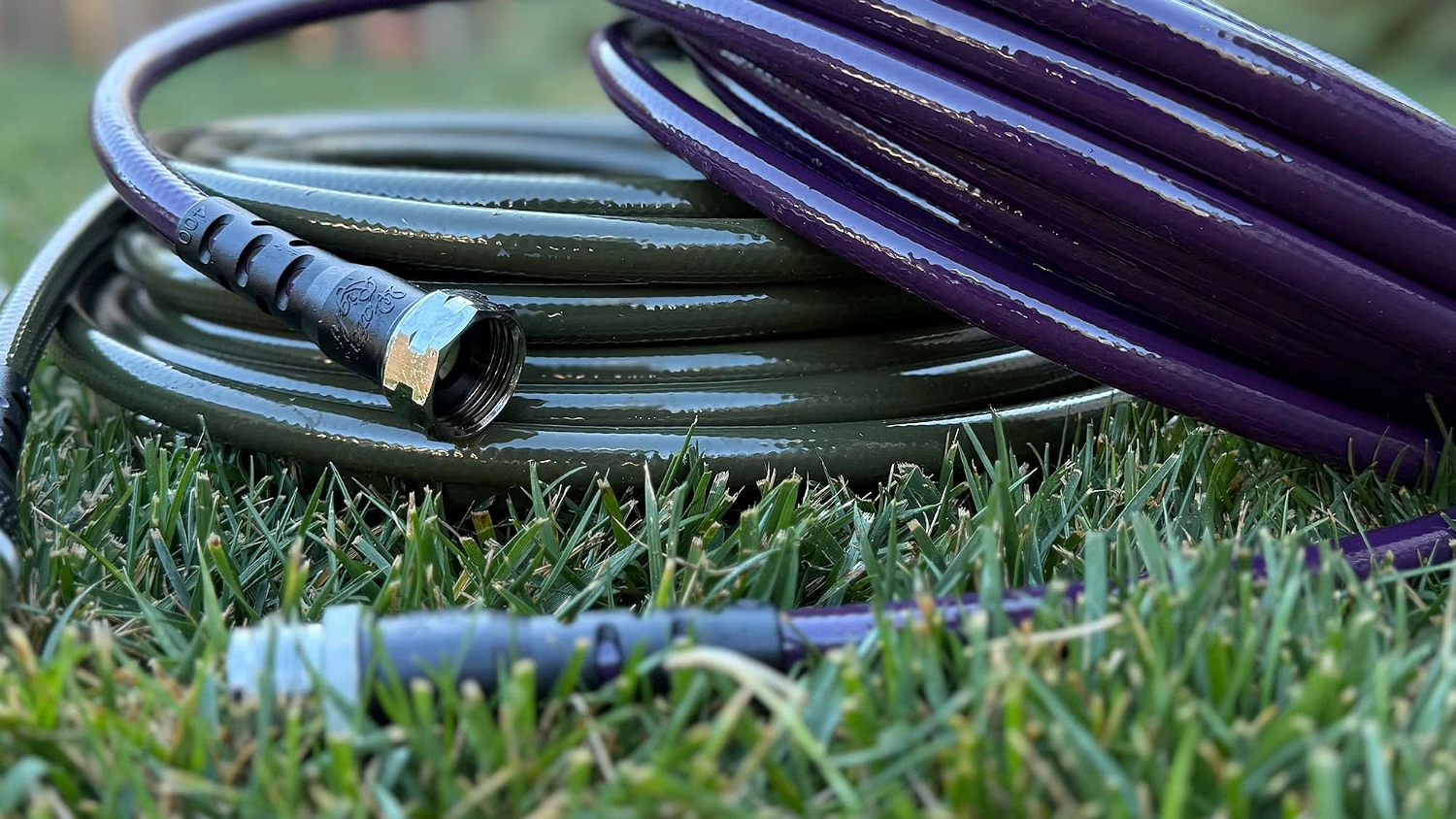
If you manage a small patio garden, raised balcony planter boxes, or a greenhouse, you do not need a heavy 100-foot commercial hose. The Water Right 400 Series Coil Hose is manufactured in the United States using 100 percent FDA-grade, BPA-free polyurethane.
- Usability: The self-coiling design automatically retracts to its compact original shape, eliminating the need for a manual hose reel. It is featherlight, making it effortless to carry without damaging delicate seedlings.
- Material Safety: The tubing meets FDA and NSF drinking water standards. It contains zero PVC, zero phthalates, and zero toxic plasticizers.
- Hardware: It features solid brass fittings plated with lead-free, commercial-grade chrome. These couplings will not leach heavy metals or corrode against your outdoor spigot.
Best Overall: Eley Polyurethane Garden Hose
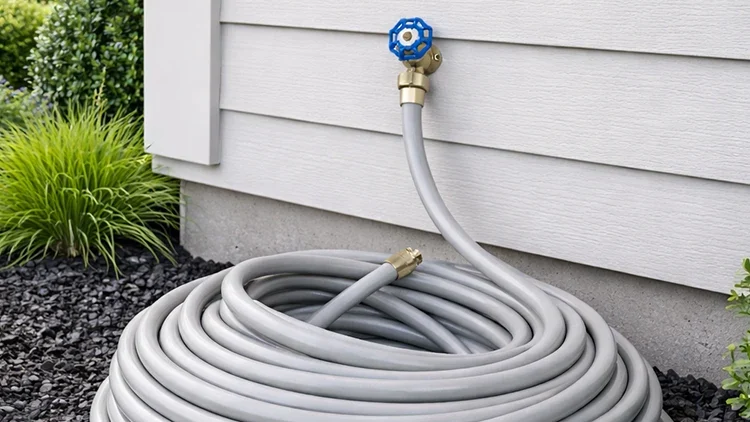
Eley produces heirloom-quality watering equipment designed to last a lifetime. Their 5/8-inch polyurethane hose is the ultimate non-toxic daily driver for organic homesteaders and home gardeners.
- Durability: The hose features thick, dual-layer polyurethane walls engineered to withstand 150 PSI working pressure and an astounding 600 PSI burst rating. It resists UV breakdown, stays flexible down to -20 degrees Fahrenheit, and resists kinking under high flow.
- Material Safety: Constructed from 100 percent pure, FDA-grade polyether polyurethane. It is completely free from PVC, phthalates, and synthetic chemical additives.
- Hardware: Eley equips their hoses with custom crush-proof, lead-free forged brass fittings. They utilize full-flow brass couplings that maximize water volume while preventing restrictive pressure drops.
Investment: Dramm ColorStorm Premium Rubber Garden Hose
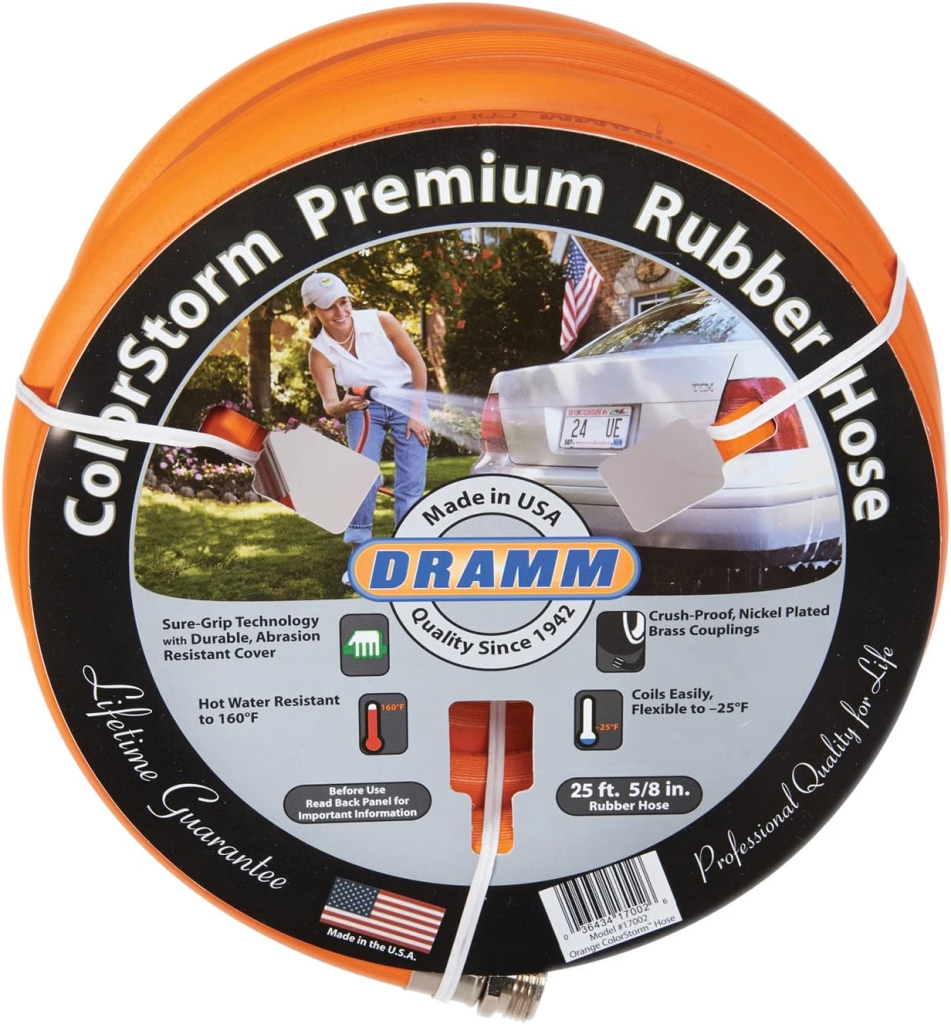
If you need maximum durability for large garden plots, farm beds, or rugged terrain, the Dramm ColorStorm is the gold standard in 100 percent EPDM rubber construction.
- Material Safety: Made from thick, commercial-grade EPDM synthetic rubber. It contains zero PVC, zero vinyl, and zero phthalates. Water passing through the Dramm ColorStorm remains completely clean and safe for edible crops.
- Hardware: Features heavy-duty, nickel-plated solid brass couplings with hexagonal wrench flats. The nickel plating provides a protective barrier against corrosion, while the thick brass threads ensure a leak-free connection to your spigot without galvanic reaction risks.
- Durability: The ColorStorm resists kinking, resists cracking under blistering heat, and remains completely flexible in freezing weather down to -25 degrees Fahrenheit. With a working pressure rating of 125 PSI and a burst strength of 500 PSI, this heavy-duty hose is built for decades of demanding outdoor work.
Simple Protocol: Flushing Your Hose Before Watering
Transitioning to non-toxic gear takes time and financial investment. If you are currently using an older PVC vinyl hose, you do not need to throw it directly into the landfill today. You can minimize chemical exposure to your soil immediately by implementing a simple flushing routine.
- Upgrade when it fails: When your current vinyl hose inevitably leaks, cracks, or loses its fittings, replace it with a certified polyurethane or EPDM rubber hose.
- Never use standing hose water on edible plants: Water that has sat inside a vinyl tube for hours or days contains the highest concentration of leached phthalates, heavy metals, and plasticizers.
- Flush for 60 seconds: Turn your outdoor spigot on full force and let the water run onto non-edible landscaping, gravel paths, or pavement for at least one full minute before directing the spray toward your vegetable beds.
- Store in the shade: Keep your current hose stored in a shaded shed, reel box, or covered area. Minimizing direct sunlight slows down the thermal breakdown of PVC polymers and reduces chemical migration into the interior water stream.
Frequently Asked Questions
What is the safest material for a garden hose? The safest materials for watering vegetable gardens and edible crops are 100 percent food-grade polyurethane and commercial-grade EPDM rubber. Both materials are chemically inert, naturally flexible, and completely free from Polyvinyl Chloride (PVC), phthalate plasticizers, and heavy metal stabilizers.
Do all garden hoses leach chemicals into the water? No. Standard PVC vinyl garden hoses leach phthalates, heavy metal stabilizers, and microplastic fragments because vinyl requires synthetic plasticizers to remain flexible. Hoses constructed from pure polyurethane or EPDM rubber do not require plasticizers and do not leach synthetic chemicals into soil or root systems.
Are stainless steel metal garden hoses safe for organic gardening? Virtually all commercially available stainless steel garden hoses hide an inner tube made of flexible PVC or low-grade vinyl. While the metal shell protects against punctures, water sitting inside the hose still comes into direct contact with synthetic plasticizers. Furthermore, most metal hoses use aluminum fittings that cause galvanic corrosion when connected to brass spigots.
How can I tell if my current garden hose has lead in it? If your hose is made of green PVC vinyl and has standard, unplated brass fittings, it likely contains trace amounts of lead. Older hoses are especially notorious for high lead content. The only definitive way to know is to use a home water testing kit on the first spray of stagnant water that comes out of the hose.
Are polyurethane garden hoses safe for organic gardening? Yes. Polyether-based polyurethane is an incredibly safe, non-toxic material. It is naturally flexible, meaning it requires zero chemical plasticizers. It is considered the gold standard for drinking water applications and organic vegetable gardening.
Do PVC garden hoses shed microplastics into the soil? Yes. Standard PVC hoses are highly susceptible to UV degradation. As the sun breaks down the outer vinyl layer, the hose chalks and sheds microplastic particles. These particles wash directly into your garden beds, altering soil density and harming beneficial soil organisms like earthworms.
What does “Drinking Water Safe” actually mean on a hose label? Usually, it simply means the hose passed NSF/ANSI 61 testing. This standard tests water flowing through the material at ambient room temperature. It does not account for the exponential chemical leaching that occurs when a hose sits stagnant in the hot summer sun. It is a helpful baseline, but not a guarantee of total safety.
Why do aluminum hose fittings get stuck to brass spigots? This happens due to galvanic corrosion. When you connect two dissimilar metals (like an aluminum hose fitting and a brass house spigot) and introduce water, an electrochemical reaction occurs. The metals literally fuse together over time, ruining both the hose and the spigot. Always match brass to brass, or use stainless steel.
Can I recycle my old PVC vinyl garden hose? No. Garden hoses are known as “tanglers” at municipal recycling facilities. They wrap around the sorting gears and break the machinery. Furthermore, PVC is a highly contaminated plastic that is rarely accepted for recycling. You must throw old vinyl hoses in the standard landfill trash.
Are expandable fabric hoses safe and non-toxic? It depends entirely on the inner tube. Most cheap expandable hoses use a highly toxic, thin latex or PVC inner bladder that bursts easily. If you want an expandable hose, you must verify that the inner core is made from food-grade polyurethane. Otherwise, they are just as toxic as standard hoses.
How long should I flush my hose before watering my vegetables? If you are using a standard PVC hose, you should let the water run onto pavement or a non-edible area for at least one to two minutes. This flushes out the stagnant water that has been absorbing concentrated plasticizers and heavy metals while sitting in the sun.
This article contains affiliate links. As an Amazon Associate, Plastic Free Everything earns from qualifying purchases at no extra cost to you.