The Kitchen Friction Audit: 5 Tools That Shed 2 Million Particles Per Use
We talk a lot about invisible plastic. Usually, we picture it floating in the rain or settling in the deep ocean. But the highest concentration of plastic exposure happens just inches from our faces, right on the kitchen counter.
In the world of polymer science, there is a concept called mechanical degradation. It is a formal way of saying that when you rub two things together, one of them loses. In your kitchen, the loser is almost always the plastic. When you add heat to that friction, you aren’t just cooking food. You are manufacturing nanoplastics.
You are likely ingesting millions of microscopic particles with a standard home cooked meal prepared with plastic tools. The science is no longer speculative. It is measurable, peer-reviewed, and sitting right in your cabinets.
Here are the five biggest offenders in your friction audit, followed by the hard truth about the “eco-friendly” bioplastics trying to replace them.
1. The Plastic Cutting Board
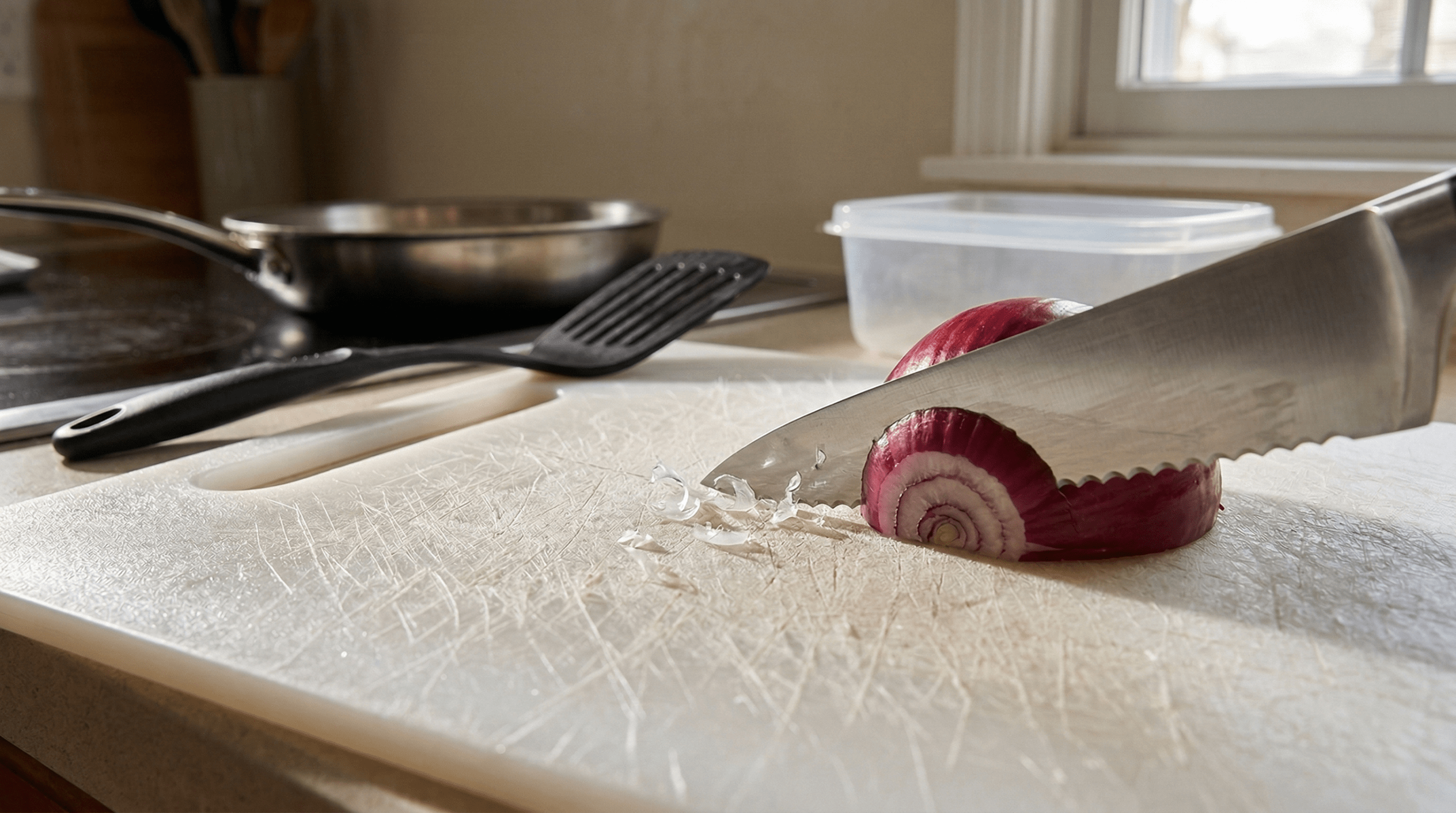
If your cutting board has scars or deep grooves from years of use, those grooves did not just disappear. They went into your onions.
A landmark 2023 study by researchers at North Dakota State University tested exactly what happens when we chop vegetables on standard polyethylene and polypropylene boards. The findings were staggering. A single knife stroke can release between 100 and 300 microplastics.
When the research team quantified this over a year of typical use, they found that a person could be exposed to up to 50.7 grams of microplastics annually just from their cutting board. For context, a standard credit card weighs about 5 grams. You could be eating ten credit cards worth of plastic shavings every single year.
- The Science: The sharp edge of the knife acts as a micro-lathe. It peels off layers of the board at a cellular level. Foods like carrots are particularly effective at “catching” these plastics due to their hard, abrasive texture.
- The Material Shift: Switch to End-Grain Wood. Wood has natural antimicrobial properties. Unlike plastic, its fibers self-heal and compress rather than shattering into synthetic shards.
2. The Black Plastic Spatula
Black plastic utensils are a staple in many homes. They hide stains well and look sleek. But recent 2024 investigations by Toxic-Free Future and the Amsterdam Institute for Life and Environment revealed a dark reality about where this material comes from.
Black plastic is notoriously difficult to recycle because standard sorting facilities use infrared light, which bounces off black pigments. To meet demand, manufacturers often source black plastic from recycled electronic waste. This includes old television casings and computer monitors.
When researchers tested black plastic spatulas, sushi trays, and slotted spoons, they found alarming levels of brominated flame retardants (BFRs). One specific chemical, decaBDE, is a known endocrine disruptor linked to cancer and thyroid issues. It was officially banned by the EPA in 2021, yet it was found in 70 percent of the tested products.
- The Risk: When you press a contaminated plastic spatula against a hot frying pan, you create the perfect storm of heat, pressure, and friction. The heat softens the polymer chains. The friction scrapes off the flame retardants directly into your cooking oil.
- The Material Shift: Use Stainless Steel or Wood, where possible. If you must use a flexible material for a delicate pan, ensure it is 100 percent Platinum Cured Silicone, which is fundamentally different from petroleum-based plastics and remains stable at high heat.
3. “Microwave Safe” Reheat Containers
The label “Microwave Safe” is one of the greatest marketing sleights of hand in consumer history. It simply means the container will not melt or explode in your microwave. It says absolutely nothing about whether it sheds particles into your food.
A 2023 study from the University of Nebraska-Lincoln shattered the illusion of safe microwaving. Researchers took FDA-approved “microwave-safe” polypropylene and polyethylene baby food containers and heated them for just three minutes. The results were terrifying.
They discovered that a single square centimeter of the plastic released up to 4.22 million microplastics and 2.11 billion nanoplastics. Nanoplastics are so small they can cross cellular membranes. When the researchers exposed human embryonic kidney cells to these extracted particles, up to 77 percent of the cells died within 48 to 72 hours.
- The Science: Microwave radiation causes water molecules in food to vibrate rapidly. This local heat creates thermal hot spots at the plastic-food interface. The heat and hydrolysis cause the surface of the container to literally slough off billions of invisible particles.
- The Material Shift: Move entirely to Borosilicate Glass or Lead-Free Ceramic. These materials are inert. They do not react to microwave radiation or undergo thermal degradation.
4. The Worn Non-Stick Pan
If your non-stick pan is flaking or has visible scratches, it is no longer a cooking tool. It is a delivery system for synthetic polymers and forever chemicals.
Research from the University of Newcastle and Flinders University demonstrated that a single scratch on a degraded non-stick coating can unleash up to 230,000 microplastic particles during a single cooking session. When these coatings are heated, they do not just flake. They off-gas.
- The Risk: These particles are often smaller than 10 microns. This means they are small enough to enter your bloodstream directly through the gut lining.
- The Material Shift: Invest in Cast Iron or Carbon Steel. Once properly seasoned with oil, these materials provide a natural, highly effective non-stick surface that adds beneficial iron to your diet instead of synthetic compounds.
5. Plastic Mesh Tea Bags
This is perhaps the most concentrated source of molecular friction in the kitchen. When you pour boiling water over a silky premium tea bag, the thermal energy causes the plastic mesh to fracture.
A landmark 2019 study from McGill University tested four different commercial teas packaged in nylon and polyethylene terephthalate (PET) bags. The researchers found that steeping a single plastic tea bag at brewing temperature releases approximately 11.6 billion microplastics and 3.1 billion nanoplastics into one cup.
- The Science: The high surface area of the mesh allows for maximum leaching. You are effectively drinking a plastic soup. Because the particles are nanoscale, they bypass standard digestive filtration and can be absorbed by human intestinal cells almost instantly.
- The Material Shift: Switch to Loose Leaf Tea with a Stainless Steel Infuser. If you prefer bags, explicitly look for brands that use unbleached paper without polypropylene sealing glue.
The Bioplastic Illusion: Greenwashing 2.0
Once people realize traditional plastic is toxic, they understandably look for an easy swap. Enter the green-striped cup. The fork that says “100% Compostable.” The takeout container stamped with a little green leaf.
These are bioplastics, usually made from Polylactic Acid (PLA) or Polyhydroxyalkanoate (PHA). They are marketed as the guilt-free solution to our waste crisis.
They are not. They are a masterclass in greenwashing.
The “Compostable” Catch
The word “compostable” implies you can throw that fork into your backyard garden bin and it will turn into soil. This is entirely false. Research from University College London’s Plastic Waste Innovation Hub found that 60 percent of plastics marketed as “home compostable” fail to disintegrate after six months in domestic compost bins.
Most bioplastics only break down in highly controlled, high-temperature industrial composting facilities. Out of the thousands of composting facilities in the United States, only a tiny fraction actually accept bioplastics. They take too long to break down and often contaminate the final soil product.
The Landfill Reality
Because you cannot compost them at home, and your city likely does not have the infrastructure to process them, bioplastics usually end up in the landfill.
When a PLA cup is trapped in a landfill without oxygen, it does not safely return to nature. It sits there for decades. Worse, as it slowly degrades anaerobically, it releases methane. Methane is a greenhouse gas roughly 30 times more potent than carbon dioxide.
The Toxicity Overlap
Just because a plastic is made from corn starch instead of petroleum does not mean it is free of toxic chemicals. A comprehensive 2024 report by Eunomia Research and Consulting highlighted that bioplastics require the exact same chemical additives, plasticizers, and stabilizers as traditional fossil-fuel plastics to achieve their flexibility and durability.
When bioplastics eventually fragment in the environment, they still create microplastics. They still leach endocrine-disrupting chemicals into the soil and water. The only difference is the original feedstock.
The Audit Conclusion: Progress Over Perfection
You do not need to empty your cupboards today. Panicking does not solve the polymer crisis.
Start where the heat is. If an item touches high heat and it is made of plastic, it is your number one priority for replacement.
- Stop microwaving plastic containers immediately.
- Throw away the scratched non-stick pan.
- Swap your plastic cutting board for wood.
- Avoid black plastic utensils entirely.
The goal is not to live in a sterilized vacuum. The goal is to reduce the internalized load of synthetic materials that our bodies were never designed to process. Ditch the bioplastic illusion, reject the greenwashing, and stick to the basics. Glass. Stainless steel. Wood. Ceramic.
Real progress starts with real materials.
Frequently Asked Questions (FAQs)
1. Does washing plastic cutting boards in the dishwasher remove the microplastics? No. The high heat and harsh detergents in a dishwasher actually degrade the plastic further. While washing removes surface bacteria, it accelerates the breakdown of the polymer chains, making the board more likely to shed microscopic shards into your food during your next meal prep session.
2. Are bamboo cutting boards truly plastic-free? Not always. Cheap bamboo boards often use formaldehyde-based glues or synthetic resins to hold the thin wooden slats together. When shopping for a replacement, look for solid wood boards or bamboo boards that explicitly state they use non-toxic, food-grade, plastic-free adhesives.
3. What makes black plastic more dangerous than clear plastic? Clear or white food-grade plastics are usually made from virgin materials. Black plastic is frequently sourced from recycled electronic waste because standard recycling sorting lasers cannot detect black pigments. This e-waste introduces highly toxic brominated flame retardants (BFRs) into kitchen tools, which can then leach into your food when heated.
4. Can I safely use plastic containers for cold food storage in the fridge? Cold storage is significantly safer than heating, as thermal degradation is the primary driver of massive particle release. However, mechanical wear is still an issue. Scraping the sides of a cold plastic container with a metal spoon will still release microplastics. Glass is the safest option for both hot and cold storage.
5. Is “BPA-Free” plastic safe to use in the microwave? Absolutely not. “BPA-Free” simply means the manufacturer replaced Bisphenol-A with a different chemical, often BPS or BPF, which have identical endocrine-disrupting effects. The 2023 University of Nebraska study proving billions of nanoplastics are released during microwaving used FDA-approved, BPA-free baby containers.
6. How do I know if my non-stick pan is releasing toxic chemicals? If your non-stick pan has any visible scratches, peeling, or flaking, it is actively shedding particles into your food. Furthermore, if you heat a dry non-stick pan above 500 degrees Fahrenheit, the chemical coating begins to break down invisibly, releasing toxic off-gassing that you can often smell.
7. Why are bioplastics considered “greenwashing” if they are made from plants? While bioplastics use renewable feedstocks like corn or sugarcane, they behave exactly like traditional plastics in the environment. They do not break down in backyard compost bins, they require chemical additives for durability, and they create greenhouse gases when sent to landfills. They perpetuate a single-use culture instead of solving the waste problem.
8. Are paper tea bags completely safe from microplastics? Many consumers assume paper tea bags are safe, but most commercial paper bags are sealed with a thin strip of polypropylene plastic glue so they do not fall apart in boiling water. You must look for brands that carry explicit “plastic-free” certifications or, ideally, switch to loose-leaf tea.
9. What exactly is a nanoplastic and why is it worse than a microplastic? Microplastics are smaller than 5 millimeters, but nanoplastics are smaller than 1 micrometer. Because of their incredibly tiny nanoscale size, nanoplastics can bypass the human body’s natural defense systems. They can cross the gut lining, enter the bloodstream, and even penetrate the blood-brain barrier.
10. Is cast iron difficult to maintain compared to non-stick plastic pans? Cast iron requires a slight learning curve regarding “seasoning” (baking oil into the pores of the metal to create a natural non-stick surface). However, once seasoned, it is exceptionally easy to clean with just hot water and a brush. Unlike plastic-coated pans that degrade after two years, a cast iron pan can easily last for over a century.