The Best Plastic-Free Electric Kettles of 2026: Stop Boiling Microplastics
Estimated Read Time: 8 Minutes
You buy organic tea. You filter your tap water to remove lead and chlorine. You pour it all into a ceramic mug. But just minutes before that, you boiled that pristine water in a device that is essentially a hot plastic injection system.
If you taste “plastic” in your tea, you aren’t imagining it.
Why Plastic Free Electric Tea Kettles Matter
Heating plastic accelerates hydrolysis, the chemical breakdown of polymers. When you flash-boil water to 212°F (100°C) inside a plastic vessel, or even a metal one with a plastic water level window, you are creating a chemical soup. A 2020 study estimated that plastic teabags alone could release billions of microplastics into a single cup. Your kettle shouldn’t be adding to that count.
The Hard Truth: It is nearly impossible to find an electric kettle that contains zero plastic. The base needs it for insulation, the handle needs it for grip, and the electronics need it for safety.
The Goal: We aren’t looking for a kettle made of wood and magic. We are looking for Zero Plastic Contact. This means the water reservoir, the inner lid, and the spout must be metal or glass. No silicone glues. No plastic steam tubes. No nylon filters.
Here are the 5 best electric kettles of 2026 that pass the “Boiling Point” test.
Quick Comparison: The “No-Contact” List
| Product | Best For | Link to Buy | Price |
| Hazel Quinn Retro | Best Overall | Amazon.com | $$ |
| Secura Double Wall | Best on a Budget | Amazon.com | $ |
| Cosori Gooseneck | Best Tech | Amazon.com | $$ |
| Cuisinart Soho | Best Value | Amazon.com | $ |
| Fellow Corvo EKG Pro | The Investment | Amazon.com | $$$ |
1. The Aesthetic Masterpiece: Hazel Quinn Retro Electric Kettle
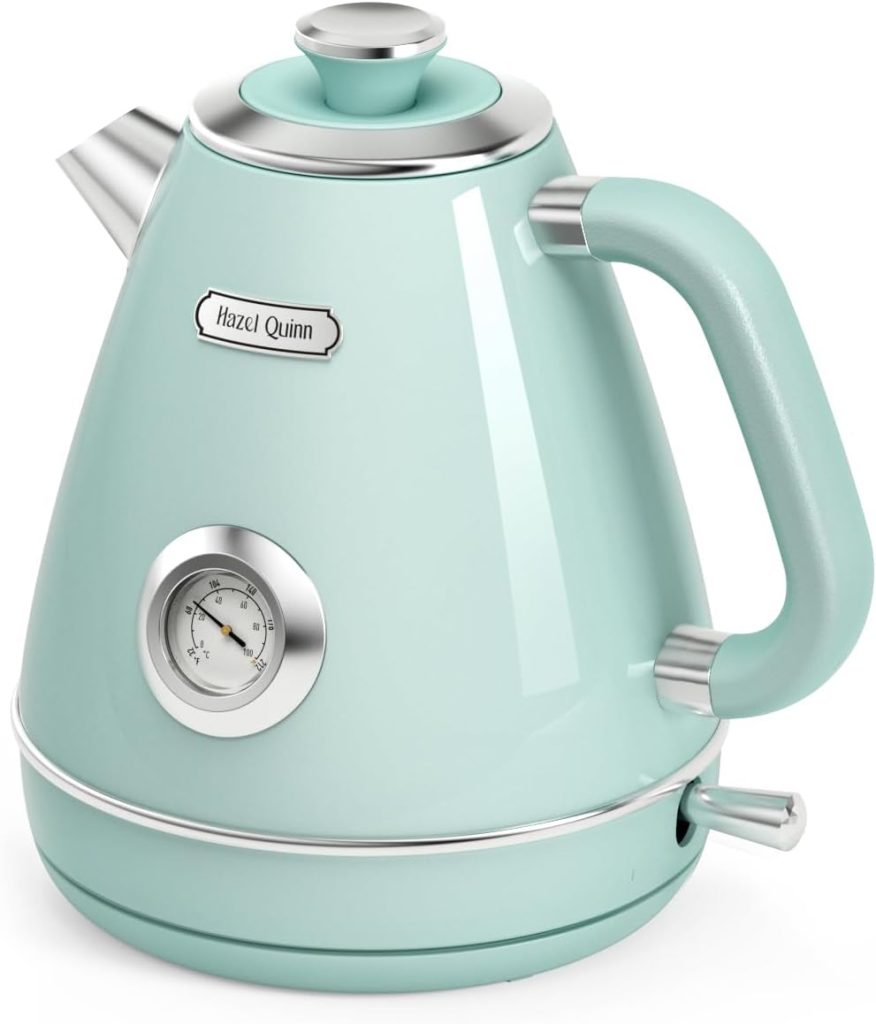
Verdict: Best Overall & Design
If you are mourning the loss of the Italian-made Ottoni Fabbrica (often out of stock in the US), the Hazel Quinn is your new best friend. This kettle solves the biggest problem in the industry: the Lid Liner. Most “steel” kettles still have a plastic disc on the inside of the lid. The Hazel Quinn is steel from top to bottom.
- The “No-Contact” Design: The interior is food-grade 304 stainless steel. There is no water window (the #1 source of leaks and microplastics). Instead, it uses a gorgeous external retro dial thermometer to show you the temperature.
- The Nuance: It uses a Strix thermostat (the gold standard for safety), but because the body is single-layer steel, it gets hot to the touch. Keep this away from toddlers.
- Why we picked it: It proves you don’t have to sacrifice style for safety. It looks like a 1950s Smeg appliance but without the plastic price tag.
Pros:
- 100% Stainless Steel Interior (Lid, Filter, Spout).
- Vintage thermometer dial (no digital screens to break).
- Zero plastic water windows.
Cons:
- Exterior gets hot.
- The lid is fully removable (some prefer a hinged lid for convenience).
2. The “Tank”: Secura Original Stainless Steel Double Wall
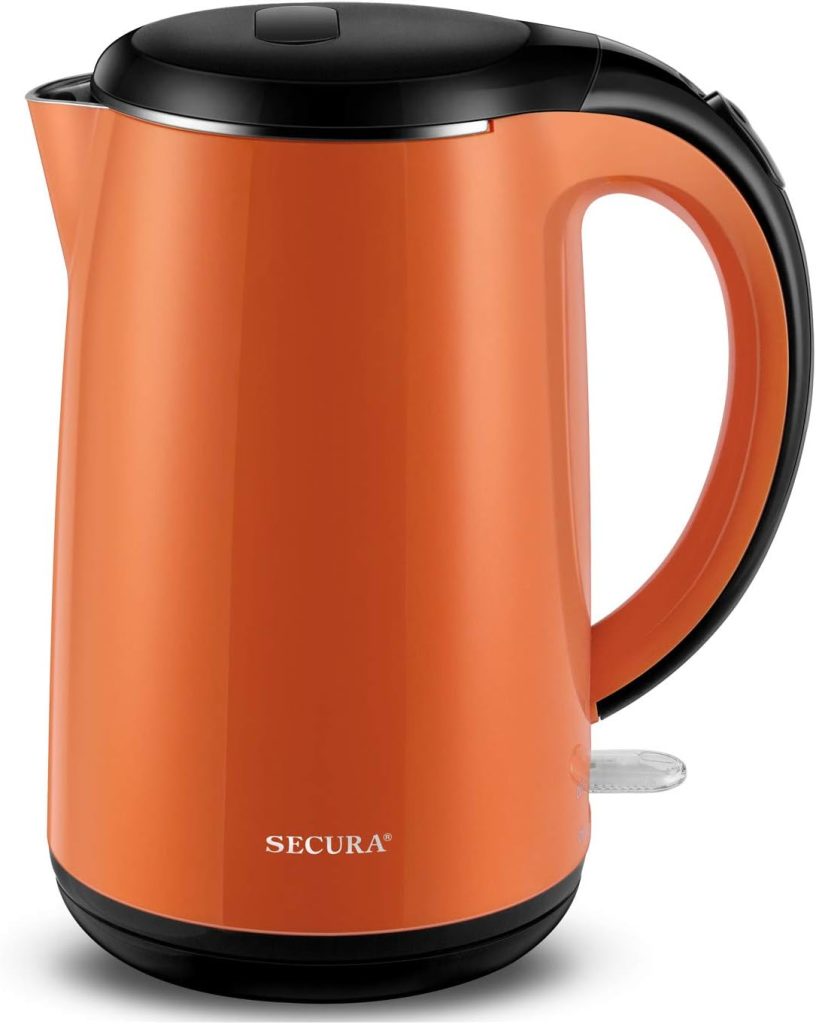
Verdict: Best Budget Option
This is the Honda Civic of kettles. It isn’t going to win a beauty contest, but it runs forever and it’s safe. Secura was one of the first brands to pioneer the “Unibody” interior, imagine a stainless steel bucket with no seams, no windows, and no glued-on parts.
- The “Greenwashing” Check: Don’t be fooled by the colorful exterior. That is a plastic shell, but it is there for insulation. It never touches the water. It essentially acts as a “jacket” for the stainless steel pot inside.
- The “No-Contact” Design: The interior of the lid is stainless steel. The pot is seamless steel. There are no silicone tubes.
- The Struggle: The spout is wide and dumpy. If you are trying to do a precise pour-over coffee, you will make a mess. This is for blasting water into a French Press or a tea mug, not for artisan brewing.
Pros:
- Unbeatable price (often under $40).
- Double-wall insulation keeps water hot longer.
- Cool-touch exterior (safe for families).
Cons:
- Bulky, utilitarian design.
- Pouring is fast and imprecise.
3. The Precision Pour: COSORI Electric Gooseneck Kettle
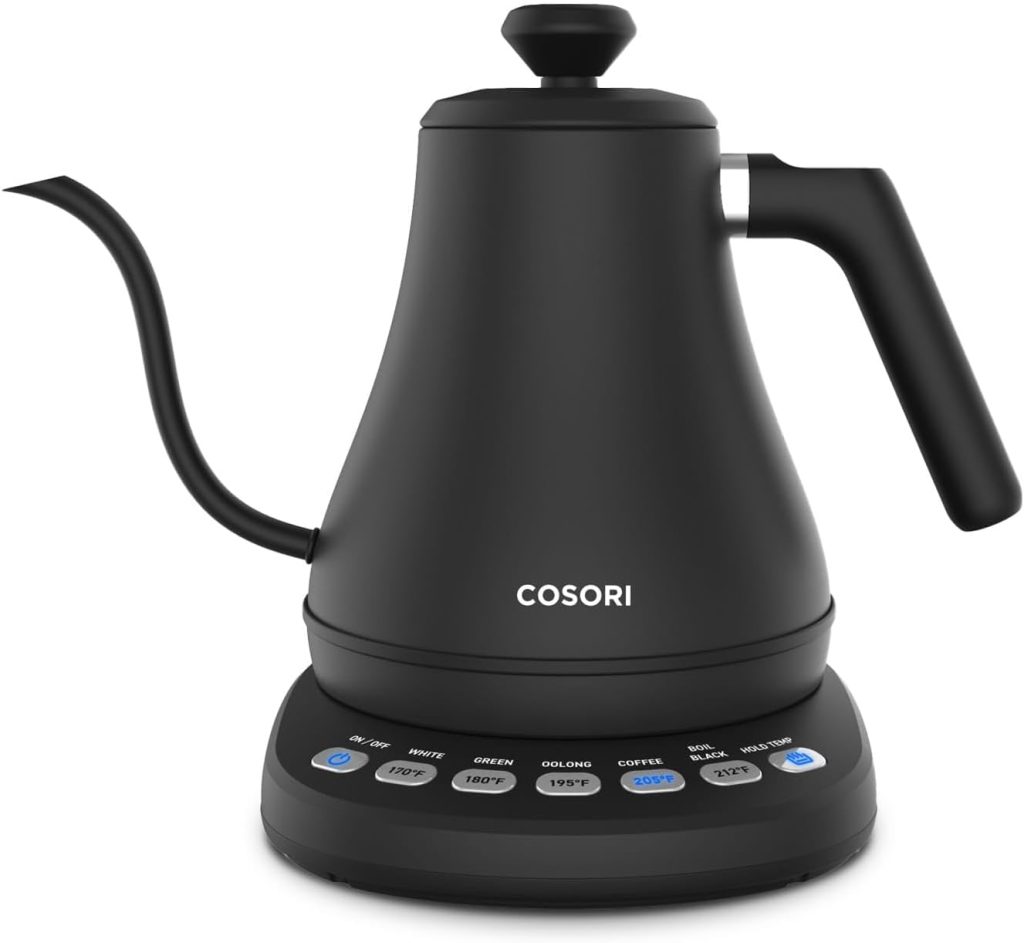
Verdict: Best for Coffee Lovers (Budget Friendly)
If you want the “barista look” without the $160 price tag, Cosori is the answer. But does it pass the toxicity test? Mostly.
- The “No-Contact” Design: The housing, lid, and spout are 304 food-grade stainless steel. They explicitly claim “no Teflon or chemical linings.”
- The Silicone Caveat: Like almost all variable-temperature kettles, there is a tiny silicone gasket around the temperature sensor at the bottom. Is this a dealbreaker? For 99% of people, no. Food-grade silicone is stable up to 400°F+. But if you are a “zero silicone” purist, stick to the Hazel Quinn.
- The Tech: This kettle allows you to dial in specific temperatures (e.g., 180°F for Green Tea vs 205°F for Coffee). This prevents you from burning your tea leaves, which is just as important for taste as the water quality.
Pros:
- Variable temperature control (presets).
- Precision gooseneck spout.
- Great price for the feature set.
Cons:
- Contains a small silicone sensor seal.
- Beeps can be loud (though some models allow you to mute).
4. The Modern Minimalist: Cuisinart Soho Double Wall
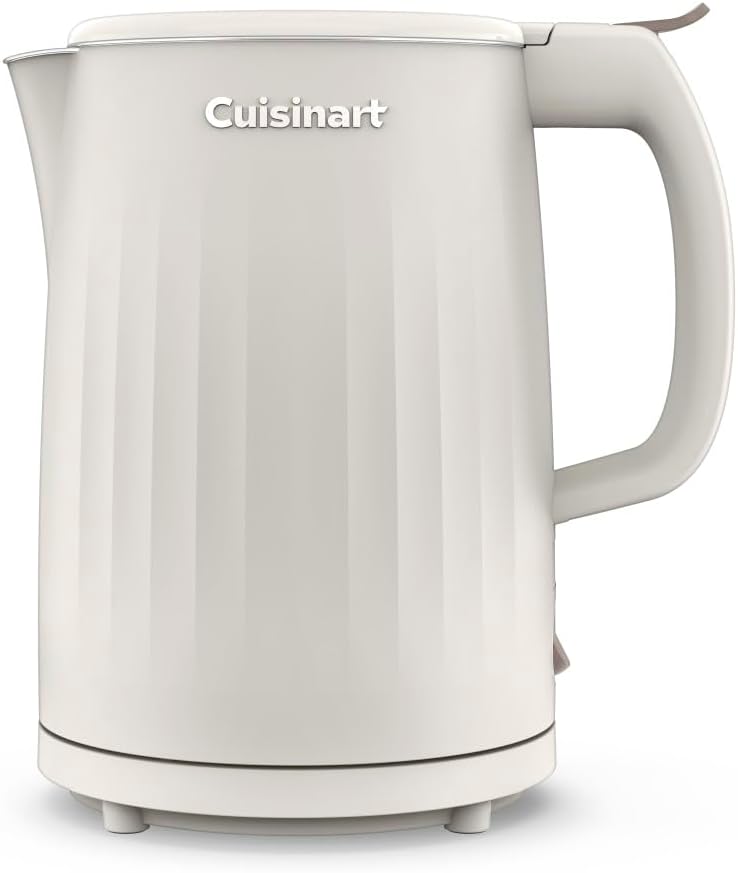
Verdict: Best Compact/Small Spaces
Cuisinart is a legacy brand, and they’ve finally caught up to the anti-plastic movement. The Soho is sleek, matte, and designed to disappear on your countertop.
- The “No-Contact” Design: Similar to the Secura, this uses a plastic outer shell for aesthetics and heat protection, but the “wetted” interior is stainless steel.
- The Hidden Flaw: While the materials are safe, the design has a quirk—the lid doesn’t open a full 90 degrees. This makes it slightly annoying to fill from a fridge dispenser or to scrub out if you have hard water buildup.
- Why buy it: It’s arguably the best-looking “safe” kettle. It doesn’t look like a spaceship or a retro prop. It just looks like a modern kitchen tool.
Pros:
- Compact 1-Liter size (perfect for dorms or solo drinkers).
- Double-wall insulation.
- Clean, matte aesthetic.
Cons:
- Lid opening is narrow (hard to clean).
- No variable temperature control.
5. The Professional’s Choice: Fellow Corvo EKG Pro
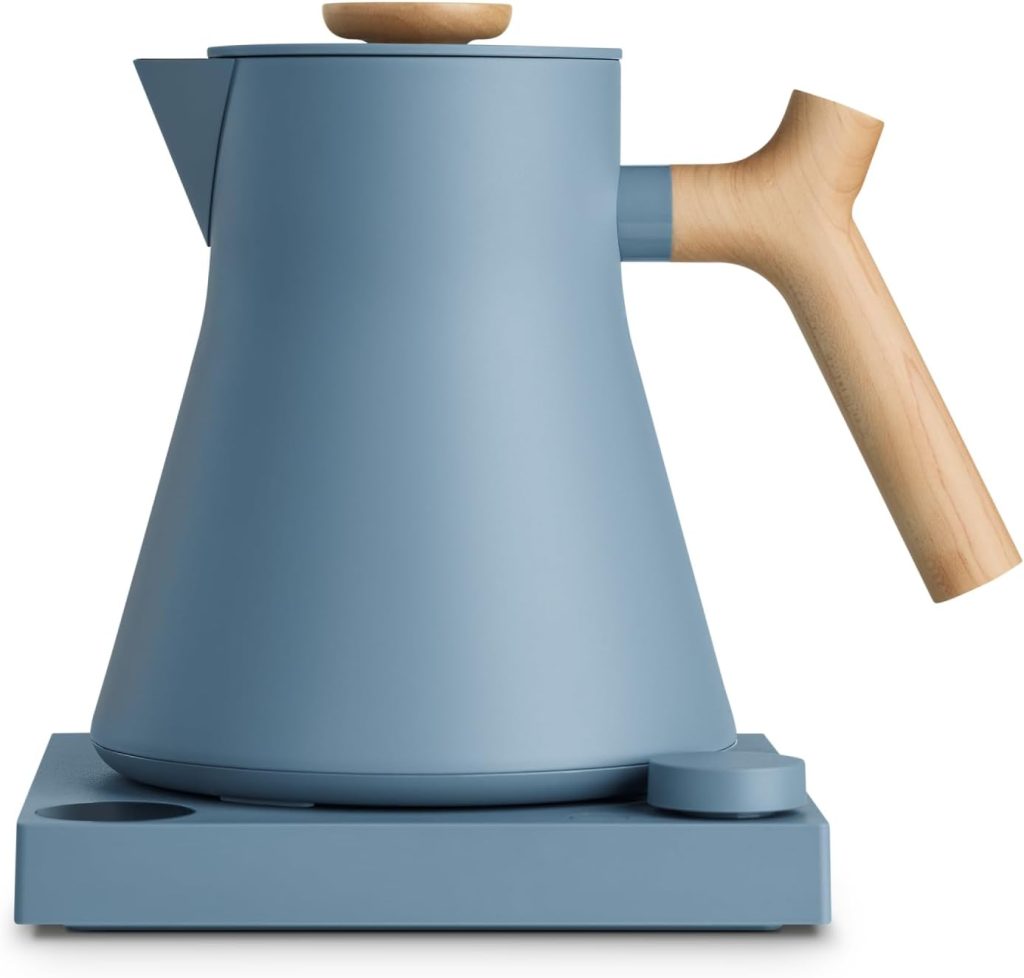
Verdict: Best “Investment” & Tea Specialist
The Fellow Corvo is the kettle you see in high-end coffee shops. It is beautiful, precise, and shockingly expensive. But is it plastic-free?
- The Nuance: This is the most controversial pick. The interior is 304 stainless steel. However, there is a silicone ring around the sensor, and the complex lid assembly often contains hidden plastic elements (though usually not in direct contact with the water).
- The “Smell” Issue: Some users report a “new electronics” smell from the base (not the water) during the first week of use. This is the heating element curing and usually dissipates.
- Why we still recommend it: If you are brewing $40 Oolong tea, you need temperature stability. The Corvo holds heat perfectly. We include it because for many, the trade-off of a tiny silicone gasket is worth the ability to hold water at exactly 195°F for 60 minutes.
Pros:
- Unmatched design and build quality.
- Full color screen with scheduling and altitude adjustments.
- Wide spout (Corvo) is better for tea than the slow-pour Stagg.
Cons:
- Very expensive.
- Not strictly “Plastic Free” (contains silicone gaskets).
Buying Guide: The “Hidden Plastic” Checklist
Before you click buy, here is the mental checklist we used to vet these products. Use this if you are shopping offline.
1. The “Window” of Deception
This is the most common trap. Manufacturers cut a hole in the steel body and glue in a clear plastic strip so you can see the water level. The glue eventually degrades, and the plastic becomes brittle. Always choose a kettle with internal water markings.
2. The Steam Tube
Cheap kettles have an auto-shutoff mechanism that relies on steam traveling down a plastic tube inside the water chamber to hit a sensor in the base. If you open a kettle and see a straw-like tube running from top to bottom, put it back.
3. The Limescale Filter
Check the spout. Many “steel” kettles have a removable mesh filter made of nylon (plastic). If you can’t remove it, don’t buy it. All the kettles on our list either have steel filters or no filter at all.
FAQ: Brewing Without Plastic
Q: Is silicone considered plastic?
A: Chemically, no. Silicone is a synthetic rubber made from silica (sand). It is generally considered more stable than plastic at high heats and does not leach microplastics. However, “purists” often avoid it because low-quality silicone can contain fillers. We mark it clearly in our reviews.
Q: How do I remove the “new kettle smell”?
A: Even stainless steel kettles can smell like a factory when new. Do not drink the first boil. Fill it to the max line, add 1/4 cup of white vinegar, boil, and let it sit for 20 minutes. Rinse thoroughly.
Q: Why are glass kettles not #1?
A: Glass seems like the best option, but they almost always require silicone sealant to bond the glass to the metal heating plate at the bottom. A “unibody” stainless steel kettle is actually cleaner than a glass one because it requires no sealants.
One Small Step
Go to your kitchen right now. Pop the lid of your current kettle. Do you see a plastic tube? Is the underside of the lid plastic? If so, you are drinking that material every morning.
For the absolute safest bet, grab the Hazel Quinn. It’s the closest thing to boiling water in a steel pot, but with the convenience of a modern switch.