Beyond the BPA-Free Lie: The Safest Baby Bottles That Won’t Shed Microplastics
If you have gone down the rabbit hole of researching infant microplastic exposure like we did, you probably landed on a terrifying statistic: babies fed using standard polypropylene bottles may ingest an average of 1.5 million microplastic particles daily.
It is a paralyzing realization for a new parent. You are trying to do everything right, including sterilizing and heating, and it turns out those very actions are creating a microscopic blizzard of plastic inside the bottle.
When you stand in the baby aisle, stared down by a wall of products proudly proclaiming BPA-Free, it feels like a cruel joke. We now know that BPA-Free is simply a marketing pivot, not a safety guarantee. Most of those bottles are still made of plastic that degrades under heat and friction.
The good news is that the solution is incredibly simple: change the material. This is not about perfection. If your baby is currently thriving on a specific plastic bottle, do not spiral. You can use the cool & pour mixing method to mitigate risk. But if you are ready to make a switch, or are building your registry from scratch, this guide cuts through the greenwashing to give you the safest, most practical alternatives to plastic feeding bottles.
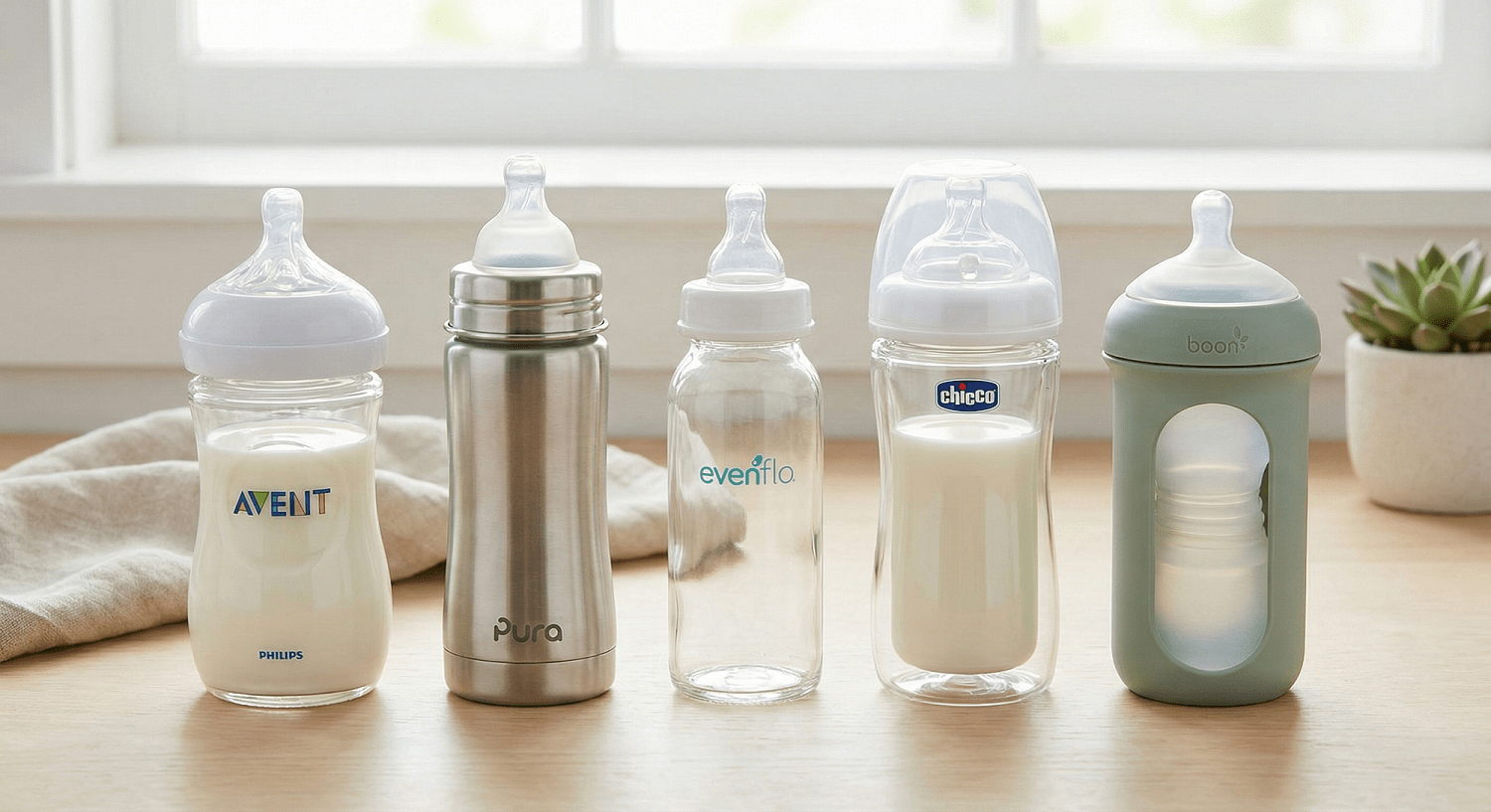
Our Top 5 Plastic-Free Baby Bottles
Quick Takeaways
| Brand | Material | Best For | Pros | Cons |
|---|---|---|---|---|
| Philips Avent Natural Glass | Borosilicate Glass | Overall Use & Combo-Feeding: Parents who want a reliable, widely available glass option with a breast-like nipple. | • Resistant to thermal shock (hot to cold ok) • Wide neck for easy cleaning • High nipple acceptance • Parts are easy to find | • Heavy for older babies to hold • Silicone sleeves must be bought separately (slippery without) |
| Pura Kiki Stainless Steel | Food-Grade Stainless Steel & Silicone | Long-Term Investment: Those wanting a 100% plastic-free, unbreakable system that grows with the child from infant to adult. | • Zero plastic (even the collar is steel) • Indestructible durability • Modular system transforms into sippy/straw cup | • Most expensive upfront cost • No visibility of milk level • Single-wall steel gets very hot to the touch |
| Evenflo Classic Glass | Standard (Soda-Lime) Glass | Budget-Conscious Parents: Building a large stash without spending a fortune, or for backup bottles. | • Extremely affordable • Simple, proven design with few parts • Easy to sanitize | • More fragile than borosilicate glass (needs a sleeve) • Narrow neck requires a bottle brush • Narrow nipple shape may not suit all babies |
| Chicco Duo | Hybrid: Glass Interior / Plastic Exterior | Durability & Lightness: Parents who want the safety of glass touching the milk but the lightweight, unbreakable nature of plastic. | • Milk only touches pure glass • Lightweight and daycare-friendly • Virtually unbreakable exterior | • Exterior is still plastic (not for plastic-free purists) • Long-term durability of internal glass layer under extreme abuse is theoretically a concern |
| Boon NURSH | 100% Silicone Pouch in Plastic Shell | Colic & Travel: Parents looking for a lightweight, air-free feeding solution without complex parts to clean. | • Collapsible pouch provides air-free feeding without vents • Lightweight and unbreakable • Milk only touches medical-grade silicone | • Can be tricky to assemble initially • Silicone pouches can hold onto odors over time |
How We Chose the Best Plastic-Free Bottles
We evaluated dozens of bottles based on criteria that matter most to exhausted parents trying to reduce toxic loads.
- Material Purity: The primary vessel must not be plastic. We prioritized borosilicate glass and high-grade stainless steel.
- Nipple Acceptance: The safest bottle in the world is useless if your baby refuses to drink from it. We looked for bottles known for breast-like nipples that support easy latching and transition.
- Ease of Cleaning: Bottles with excessive parts, narrow necks that require special brushes, or internal vents that trap mold were downgraded.
- Durability & Practicality: We considered how the bottle handles real-world abuse, thermal shock, and the demands of daycare.
The Best Plastic-Free Baby Bottles
Here are our top recommendations categorized by budget and lifestyle needs.
1. Best Overall: Philips Avent Natural Glass
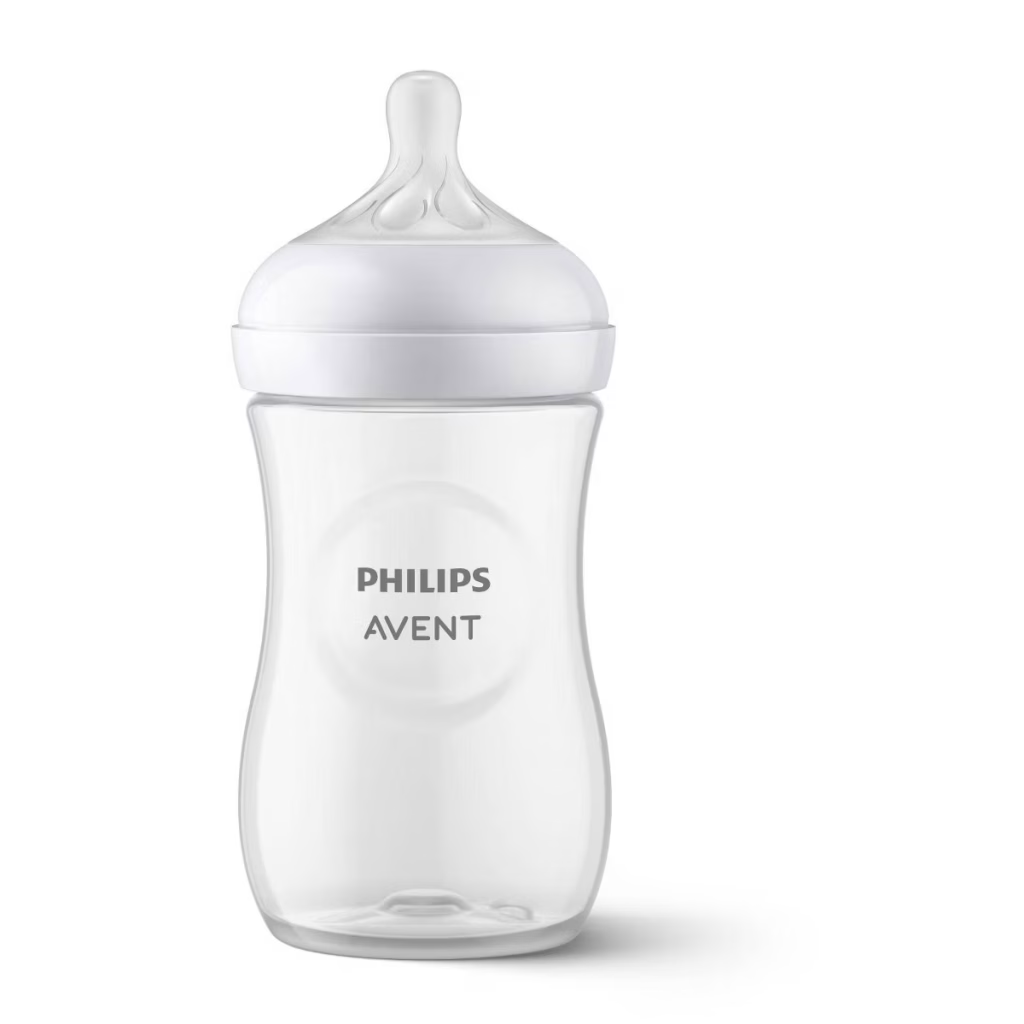
If you want a reliable, widely available glass bottle that babies generally take to easily, this is the one. Philips Avent is a massive player in the space, which means finding replacement nipples or compatible breast pump adaptors is easy.
These are made from premium borosilicate glass, so they handle temperature swings from freezer to warmer like a champ. The wide neck makes them incredibly easy to clean without a specialized brush, and it also makes dumping scoops of formula powder mess-free.
The natural nipple is designed to be broad and breast-shaped to encourage a wide latch, making these a favorite for parents who are combo-feeding (moving between breast and bottle).
Pros
- Borosilicate glass has a high thermal shock resistance.
- Wide neck for easy cleaning and filling.
- Nipple design has a high acceptance rate for breastfed babies.
- Easy to find parts at big-box stores.
Cons
- They are heavy. A 4oz bottle is manageable, but the 8oz version full of milk is a heft for a small baby to learn to hold.
- Most packs do not come with silicone sleeves (sold separately), so they are slippery when wet. We’ve linked the only version we’ve seen sold with sleeves above.
2. The Investment: Pura Kiki Stainless Steel System
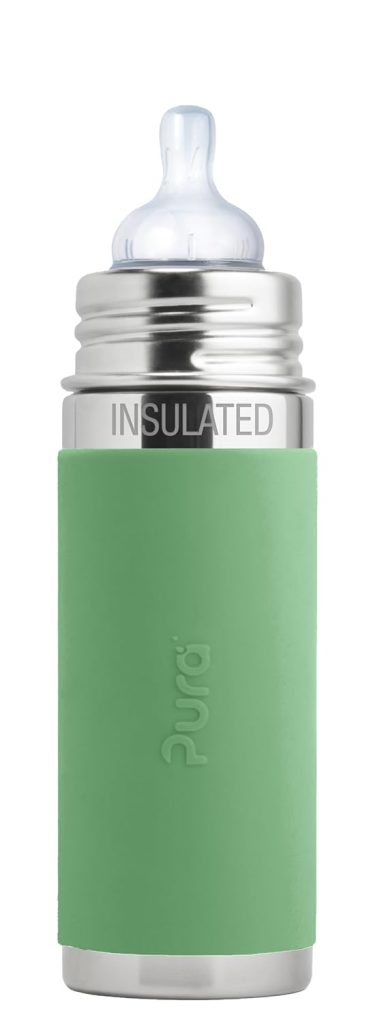
If you hate the idea of buying waves of products that become obsolete every six months, the Pura Kiki system is your buy it for life solution.
This is not just a baby bottle; it is a modular hydration system. You buy the stainless steel bottle, and by simply swapping the silicone top, it transforms from a newborn bottle to a sippy cup, to a straw bottle, to a snack container, and finally to a sport water bottle for an adult.
Pura is also the only bottle on the market that is certified 100% plastic-free. Even the collar that holds the nipple is stainless steel (most other glass/steel bottles still use a plastic collar). The only materials are steel and silicone.
Pros
- The only 100% plastic-free option (even the collar is steel).
- Completely indestructible
- Grows with the child from infant to adult.
- These hold their value well on the second-hand market.
- Most daycares that ban glass will accept these because they don’t break.
Cons
- Most expensive option upfront.
- There is no visibility so you cannot see how much the baby has drunk. You have to guess by weight.
- The single-walled steel gets very hot if you use warmer water. Pura sells silicone sleeves to mitigate this. You can also buy the insulated version.
3. The Budget Pick: Evenflo Classic Glass
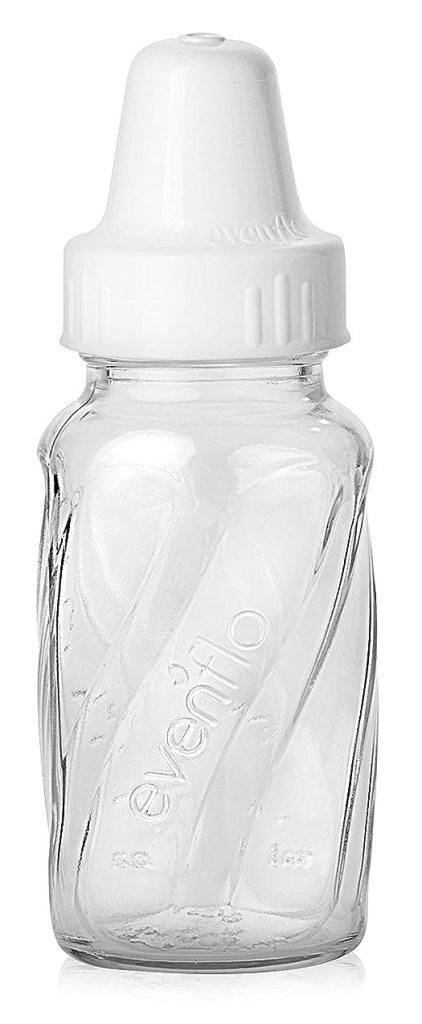
You do not need to spend a fortune to avoid microplastics. Evenflo has been making these bottles almost exactly the same way for decades. They are simple, effective, and incredibly affordable.
They are standard-neck bottles made of tempered glass. They are not as resistant to thermal shock as borosilicate, and the narrow neck makes cleaning a bit harder, but they get the job done without plastic.
These are an excellent option for building a large stash on a budget, or for having backups at grandparents’ houses.
Pros
- The price is unbeatable value for a glass product.
- Simple design with only three parts to clean (bottle, nipple, collar).
Cons
- It is standard glass, not borosilicate, so they are more prone to breaking if dropped. We highly recommend buying generic silicone sleeves for them.
- The narrow neck is harder to pour formula powder into and requires a bottle brush for cleaning.
- The standard narrow nipple is less like a breast, which some babies may reject if they are used to a wider latch.
4. The Innovative Hybrid: Chicco Duo
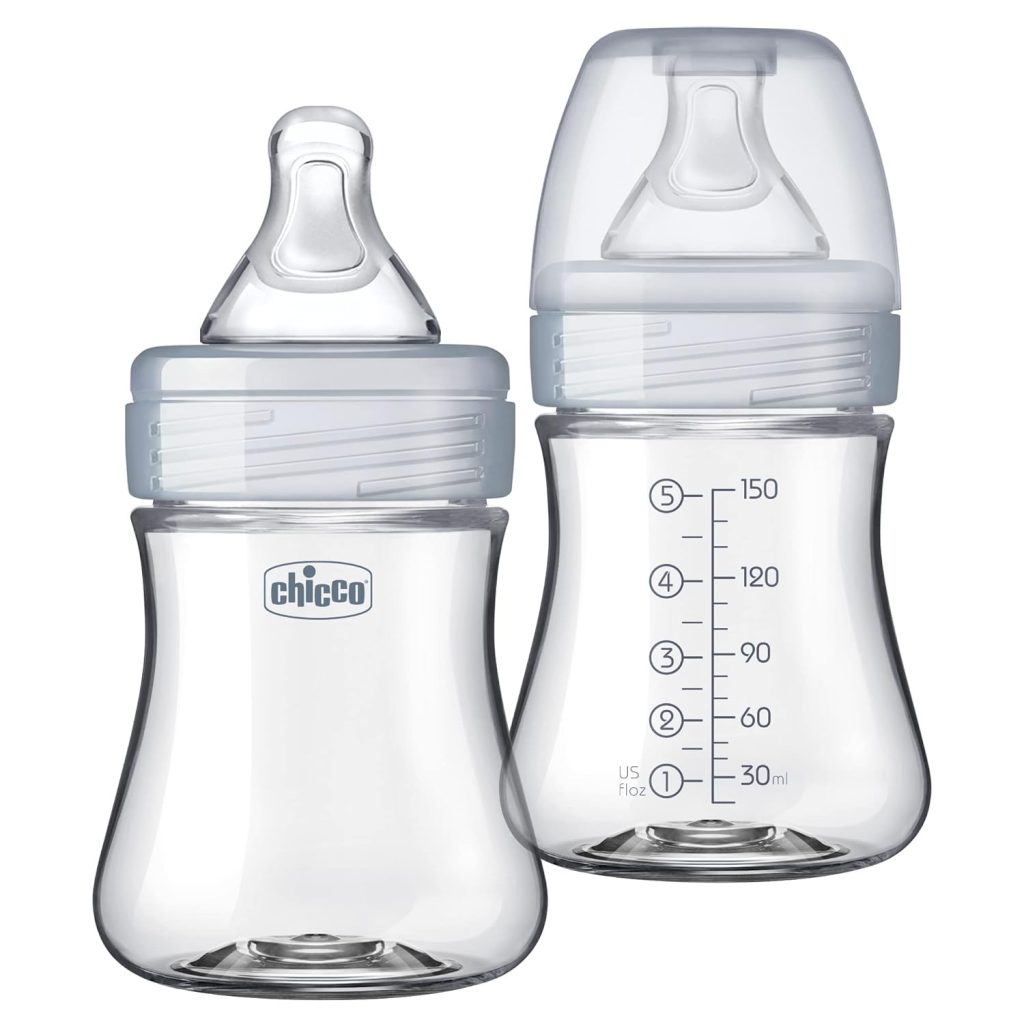
This bottle broke the mold when it was released. It is the answer to the parent who says, “I want the safety of glass but the lightness of plastic.”
The Chicco Duo uses a patented technology where the inside of the bottle is a micro-thin layer of pure glass. The outside structure is plastic.
Because the glass layer is bonded to the plastic and is incredibly thin, the bottle is lightweight and virtually unbreakable. If you drop it, the outer plastic absorbs the shock, protecting the inner glass lining from shattering. It is a brilliant piece of engineering that solves the main drawbacks of traditional glass bottles.
Pros
- Glass interior so the milk only touches inert glass.
- Lightweight bottle weighs about the same as a standard plastic bottle.
- Durable and won’t shatter on tile floors.
- Most daycares that ban glass will accept these because they don’t break.
Cons
- While the inside is glass, the outside is still plastic. If you are trying to eliminate all plastic from your home environment, this isn’t it.
- While very durable, it is theoretically possible for the inner glass layer to develop micro-cracks over years of intense abuse, though reports of this are rare.
5. Best Silicone Option: Boon NURSH
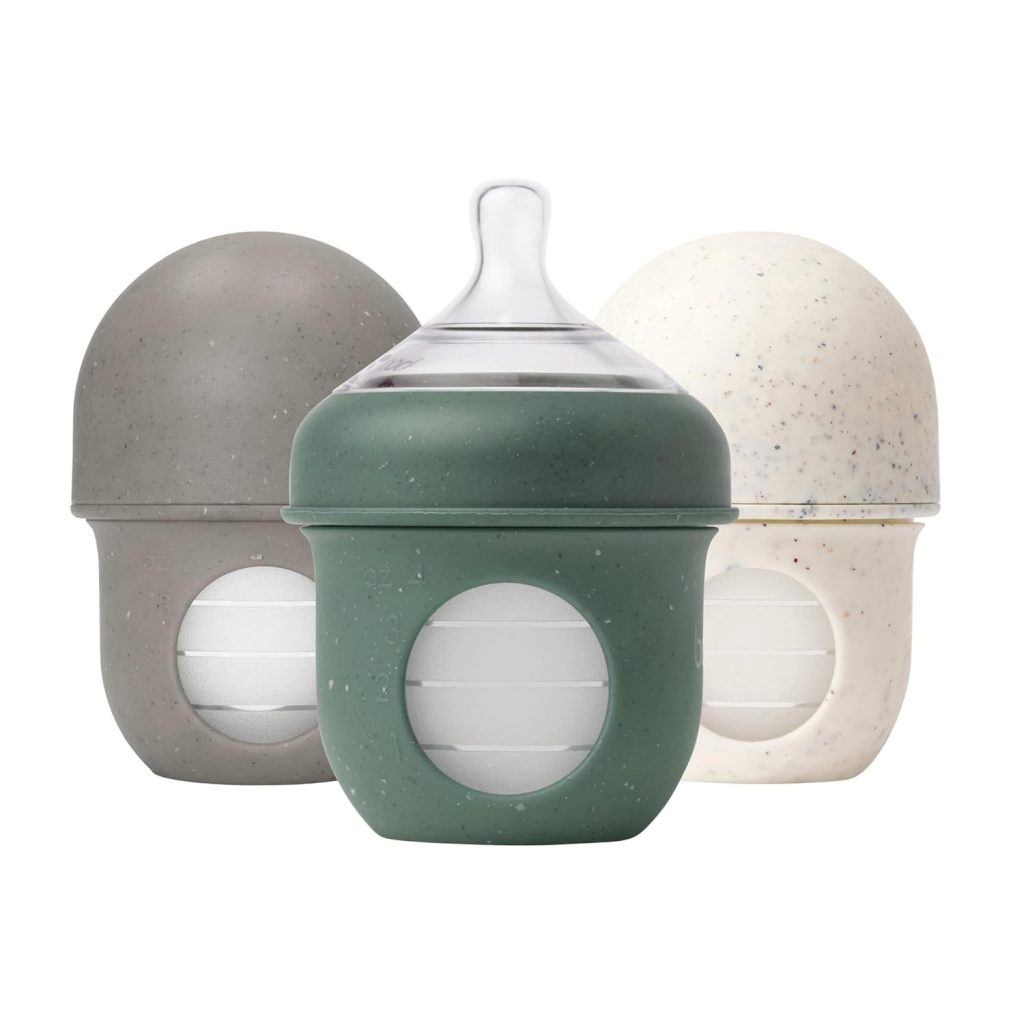
If glass or steel feel too heavy or clunky, silicone is the next best alternative. The Boon NURSH system is unique because it features a reusable plastic outer shell that holds a collapsible silicone pouch.
The milk only ever touches 100% medical-grade silicone. The genius of the design is that as the baby drinks, the silicone pouch collapses inward. This naturally eliminates air bubbles without needing complex venting systems, straws, or valves that are impossible to clean.
It is incredibly lightweight, the silicone feels natural to the baby, and it is virtually unbreakable.
Pros
- Excellent for colic without complex parts.
- It is both lightweight & durable so it’s great for travel and tossing in a diaper bag.
- The silicone pouches turn inside out for thorough washing.
- Milk only touches silicone, not the plastic outer shell.
Cons
- It takes a few tries to get the hang of clicking the silicone pouch into the shell correctly.
- Like all silicone, the pouches can start to smell like dishwasher detergent over time. You may need to boil them occasionally with vinegar to refresh them.
Evaluating Materials for Microplastic-Free Feeding
When you strip away the marketing, there are really only three viable alternatives to plastic bottles. Each has distinct pros and cons regarding durability, weight, and cost.
1. Glass (The Gold Standard)
Glass is inert. It does not react with milk, it does not leach chemicals, and it does not shed particles when heated. It is the easiest material to clean and sanitize fully without degradation.
- Borosilicate Glass: This is pharmaceutical-grade glass, the same type used in laboratory beakers. It is highly resistant to thermal shock, meaning you can take it from a cold fridge and put it immediately into a bottle warmer without it cracking. It is generally lighter and stronger than standard glass.
- Soda-Lime Glass: This is standard glass, like a mason jar. It is cheaper but heavier and more susceptible to breaking from rapid temperature changes.
The Downside: Gravity. Glass breaks. While many modern glass bottles are surprisingly durable and often come with silicone protective sleeves, they will not survive a high drop onto a ceramic tile floor. Many daycares also ban glass bottles due to safety concerns.
2. Stainless Steel (The Tank)
Food-grade stainless steel (usually 304 grade) is virtually indestructible. Like glass, it is inert and will not leach chemicals or shed microplastics into warm milk. It is lighter than glass but heavier than plastic.
The Downside: Lack of transparency. You cannot see how much milk is left inside the bottle, which can be frustrating during a feed. You also cannot check for proper mixing of formula powder visually. Steel also conducts heat very efficiently, so the outside of the bottle can feel very hot to the touch if filled with warm water.
3. Medical-Grade Silicone (The Compromise)
Silicone is technically a synthetic polymer, but its backbone is silicon (derived from sand) and oxygen, rather than a carbon chain like plastics. It is much more stable under heat than polypropylene and is not known to shed microplastics in the same way.
It offers the lightweight, unbreakable benefits of plastic without the same leaching concerns. It is often squishy and mimics the tactile feel of a breast, which some babies prefer.
The Downside: Silicone can hold onto odors (like stale milk or dishwasher soap smell) much more stubbornly than glass or steel. It also tends to attract dust and lint due to static.
A Note on Nipples and Plastic Components
A common question is, “If I buy a glass bottle, isn’t the nipple still plastic?”
Bottle nipples are almost universally made of silicone or natural rubber latex, not plastic. These materials are flexible and heat-stable.
However, almost every glass or silicone bottle on the market (with the exception of the Pura Kiki stainless steel) still uses a plastic screw collar to attach the nipple to the bottle.
Is this a problem? It is a matter of calculated risk.
The milk does pass over the plastic collar briefly during a feed. However, the milk is not being heated inside the plastic collar, nor is it sitting in contact with it for prolonged periods under agitation.
Compared to a full bottle made of polypropylene releasing millions of particles throughout the entire volume of milk during preparation, the exposure from a plastic collar is negligible.
If you want zero plastic anywhere near the milk, the Pura Kiki (which uses a steel collar) or certain LifeFactory models (which use a silicone cap over the glass) are your only options. For most parents, a glass vessel with a plastic collar is a massive victory in microplastic reduction.
Progress over perfection.
FAQs About Plastic-Free Feeding
1. Do glass baby bottles break easily?
Borosilicate glass bottles are surprisingly tough and resistant to temperature changes. However, they are still glass. If dropped from a high chair onto a tile or concrete floor, they will likely break. Using silicone sleeves significantly increases their survival rate.
2. Why do some daycares ban glass bottles?
Daycares are burdened with liability. The risk of shattered glass in a room full of crawling infants is a risk many directors are unwilling to take. The Chicco Duo (glass inside, plastic outside) or silicone bottles like the Boon NURSH are great daycare-friendly alternatives that still avoid plastic contact with milk.
3. Are silicone bottles better than plastic?
Yes. While silicone is a synthetic polymer, its chemical backbone is different from petroleum-based plastics. It is significantly more stable under heat and is not known to shed microplastics into food in the way polypropylene does.
4. How do I warm milk in a stainless steel bottle?
You can use most standard bottle warmers, or simply place the bottle in a mug of hot water. As stainless steel conducts heat very quickly, the outside of the bottle will feel much hotter than the milk inside, so always test the milk temperature on your wrist before feeding.
5. Can I just use older plastic bottles if they are BPA-Free?
If your goal is to avoid microplastics, no. Older BPA-Free bottles are almost certainly made of polypropylene, which is the primary culprit in microplastic shedding when heated or shaken.
6. Is the plastic collar on glass bottles a problem?
It is a very minor source of exposure compared to a plastic bottle. The milk only briefly touches the collar during active feeding. It is not being heated or stored in contact with the collar. If you want to eliminate even that risk, look for the Pura Kiki stainless steel system.
7. Are glass bottles too heavy for a baby to hold?
Initially, yes. A young infant will not be able to hold a glass bottle. However, by the time a baby is developmentally ready to hold their own bottle (usually around 6-9 months), they are usually strong enough to manage a smaller glass bottle with a silicone grip sleeve.
8. Do I need special brushes to clean glass bottles?
It depends on the design. Wide-neck bottles (like the Philips Avent or Chicco Duo) can often be cleaned with a standard kitchen sponge. Narrow-neck bottles (like the Evenflo Classic) will require a bottle brush to reach the bottom corners effectively.
9. Can I freeze milk in glass bottles?
Only if they are made of borosilicate glass. Standard soda-lime glass may crack if the liquid inside expands during freezing. Even with borosilicate, you should leave headspace at the top for expansion and avoid rapid temperature shocks (like running hot water over a frozen glass bottle).
10. Are bamboo baby bottles a good alternative?
Be careful with bamboo products. Solid bamboo wood is not suitable for a bottle. Many bamboo fiber products are actually bamboo dust mixed with a melamine or plastic resin binder, which is just another form of plastic. Stick to glass, steel, or medical-grade silicone for safety.

This article contains affiliate links. As an Amazon Associate, Plastic Free Everything earns from qualifying purchases at no extra cost to you.