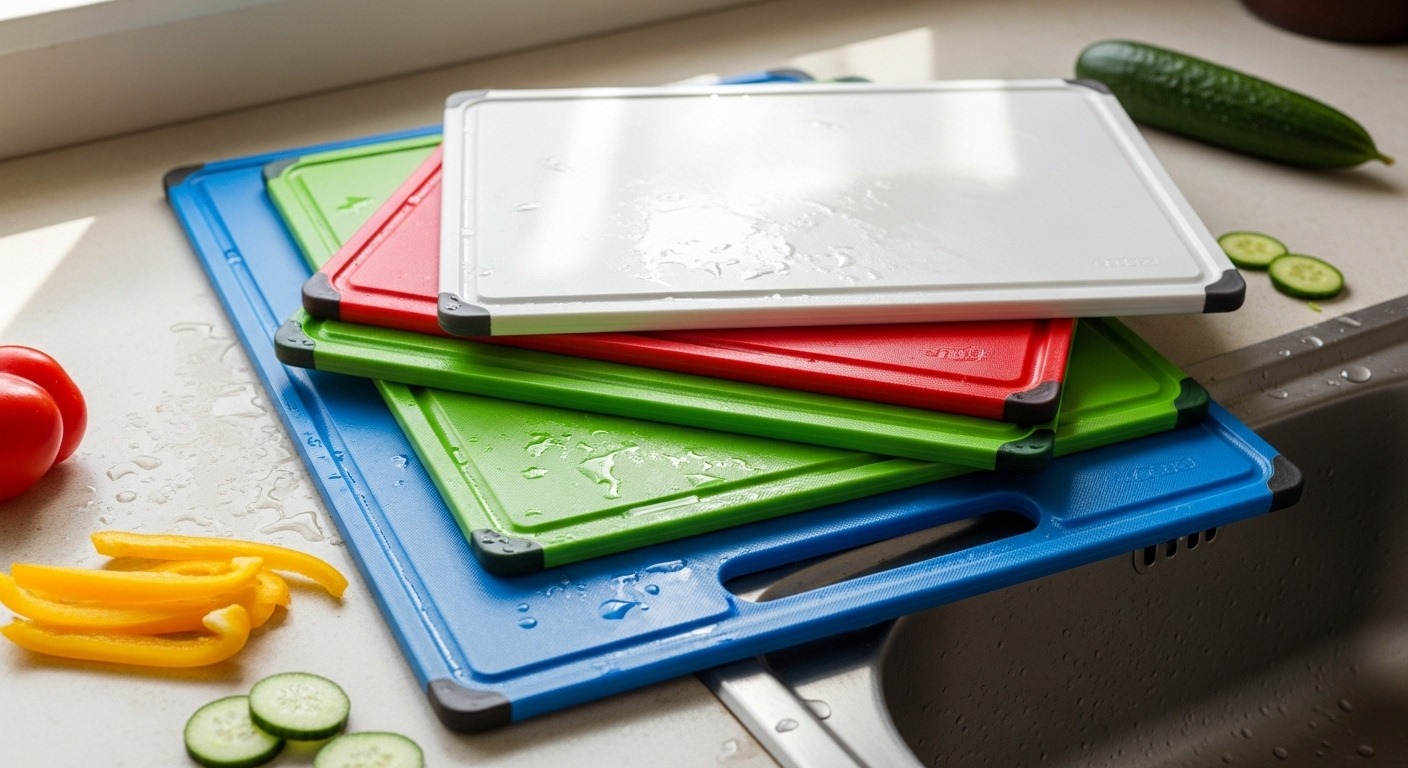
The Microplastic Migration: Mapping the journey from your cutting board to your bloodstream
We’ve all heard the statistic: the average person ingests roughly a credit card’s worth of plastic every week. We visualize this as plastic straws or water bottle caps floating in the ocean. But the reality is much closer to home.
Every night, as we prep dinner, we take a sharp knife and hack away at a slab of polyethylene or polypropylene. We are literally carving microscopic shrapnel directly into our onions and peppers.
This isn’t just about “being green.” This is about the polymer chemistry of your dinner. It is time to look at the “Invisible Kitchen” and understand why that scarred, stained white plastic board is a liability your body is forced to process.
Related: View our post on the Best Wooden Cutting Boards You Should be Using in your Kitchen.
The Mechanics of Shedding: Why Plastic Doesn’t Just “Wear Down”
When you use a knife on a plastic surface, you aren’t just creating a groove. You are initiating a process called mechanical weathering. Unlike wood, which has a cellular structure that can “self-heal” or close around a knife edge, plastic is a rigid polymer chain. When the blade strikes, it severs those chains.
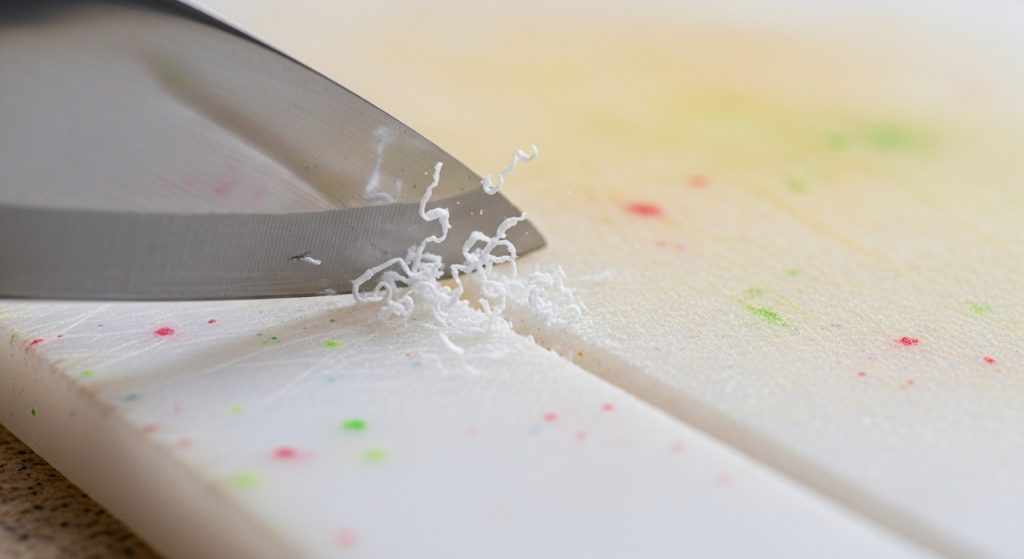
A 2023 study published in Environmental Science & Technology provided the data we’ve been missing. Researchers at North Dakota State University found that chopping on a plastic board can produce between 14 million and 79 million polyethylene microplastics per year. If you use a polypropylene board, that number creates a steady stream of synthetic intake.
These particles aren’t just “out there” in the environment. They are on your knife. They are in the garlic you just minced. They are entering your digestive tract before the meal is even finished.
The Porosity Myth: Why Plastic Is Actually Filthier Than Wood
For decades, the plastic industry pushed a very specific narrative. They told us that plastic was “hygienic” because it is non-porous. They claimed that wood was a bacterial breeding ground because it has “pores” that soak up meat juices.
It was a brilliant marketing play. It was also scientifically backwards.
Researchers, most notably Dr. Dean Cliver at the University of California, Davis, conducted landmark studies comparing wood and plastic cutting boards. They found that on wooden boards, bacteria actually sank below the surface via capillary action. Once trapped inside the wood fibers, the bacteria didn’t multiply, but rather they died.
Wood has natural antimicrobial properties designed to protect the living tree from fungus and infection.
On the other hand, plastic boards develop deep scars over time. As noted in Dr. Cliver’s research summary, these “knife tracks” are the perfect size for microscopic food particles and bacteria to hide.
Because plastic is hydrophobic, your dishwasher can’t always get deep into those jagged crevices to sanitize them. You end up with a surface that is both shedding plastic and harboring old bacteria.
The Chemistry of the “Leach”
It isn’t just the physical flakes of plastic that should concern us. It is the chemical cocktail used to make those boards “durable” and “colorful.”
Most plastic cutting boards are made from High-Density Polyethylene (HDPE). While HDPE is often touted as “BPA-free,” that is a low bar to clear. Being BPA-free doesn’t mean a product is free of endocrine-disrupting chemicals.
When you heat these boards, say, by putting them in a high-temp dishwasher. the polymer structure weakens. This increases the rate of leaching. If you then chop acidic foods (like lemons or tomatoes) or hot proteins on that weakened surface, you are creating a highway for chemical migration from the board into the food.
This is particularly concerning given that microplastics are widely detected in human blood, proving that these particles can travel through the body and potentially lodge in organs.
The “Wheat Straw” Propaganda
As consumers have become more aware of plastic’s downsides, a new “eco-friendly” alternative has flooded the market: Wheat Straw cutting boards.
These boards look speckled and “natural.” The marketing tells you they are made from agricultural waste. What they don’t tell you is that wheat straw cannot be molded into a board on its own. It needs a binder. In almost every case, that binder is polypropylene resin, often making up 20-30% or more of the product.
These boards are essentially “fiber-reinforced plastic.”
They cannot be composted.
They cannot be recycled.
And because the wheat straw makes the material more brittle, they often shed even more microplastics than a standard HDPE board. It is the ultimate “green” bait-and-switch.
Breaking the Habit: How to Transition
I know what you’re thinking. Plastic boards are cheap. They’re light. You can toss them in the dishwasher and forget about them. Switching to wood feels like “work.”
But consider the long-term cost of the “cheap” option. You are paying for that board with your endocrine health.
If you are ready to stop eating your cookware, the solution is remarkably simple. You need a high-quality, end-grain or edge-grain wooden board. These boards are designed to preserve your knife’s edge and protect your health.
We’ve done the heavy lifting for you here. If you want to know which woods are truly food-safe and which brands actually stand behind their sustainability claims, check out our guide on the best wooden cutting boards you should be using in your kitchen.
Choosing Your New Surface: Budget vs. Investment
If you’re ready to purge the plastic, here is how to shop:
- Budget: Look for Rubberwood or Acacia edge-grain boards. These are often available at big-box stores. They require more frequent oiling, but they are a massive upgrade over plastic.
- Best Overall: Maple or Walnut edge-grain boards. These are the workhorses of the kitchen. They are dense, durable, and have a proven track record for hygiene.
- Investment: End-grain Larch or Walnut “Chopping Blocks.” In an end-grain board, the wood fibers stand vertically. When your knife hits the board, the fibers part and then close back up. These boards can last a lifetime and are the kindest to your knives.
The Cleanup: It’s Easier Than You Think
The fear of maintaining wood is largely overblown. You don’t need a degree in carpentry to keep a wooden board clean.
- Wash with soap and water. Yes, you can use dish soap. Just don’t soak the board in the sink.
- Dry it immediately. Stand it up on its side so air can circulate around both sides.
- Oil it once a month. Use a food-grade mineral oil or beeswax. This keeps the wood from drying out and creates a natural barrier against moisture.
FAQs
Is it safe to cut raw meat on a wooden cutting board? Yes. As shown in the UC Davis food safety studies, wood is often safer for raw meat than plastic. The wood’s natural capillary action draws bacteria down into the fibers where they eventually die off, whereas knife scars on plastic boards can harbor bacteria that resist washing. Make sure to thoroughly clean your cutting board every time you use it, especially when cutting raw meat.
Can I put a wooden cutting board in the dishwasher? Absolutely not. The high heat and prolonged exposure to water will cause the wood to warp, crack, and eventually split.
Are bamboo cutting boards a good plastic-free option? Bamboo is a grass, not a wood. It is very hard (high silica content), which can dull your knives quickly. Furthermore, consumers should be wary of adhesives; some cheap bamboo boards are held together with formaldehyde-based glues. If you choose bamboo, ensure it is from a reputable, FSC-certified brand that uses food-safe adhesives.
What should I do with my old plastic cutting boards? Don’t donate them, you’d just be passing the microplastics on to someone else. Unfortunately, most curbside recycling programs won’t take scarred HDPE boards. The best use is to repurpose them for non-food tasks, like a protective surface in the garage.
How do I know if my wooden board needs oiling? Sprinkle a few drops of water on the board. If the water beads up, the board is well-seasoned. If the water soaks into the wood, it’s time for a fresh coat of oil.
Which plastic-free cutting board material is best for professional-grade knives? If you use high-carbon steel or expensive Japanese knives, End-Grain Maple or Hinoki (Japanese Cypress) are the superior choices. Unlike plastic, which can be surprisingly “grabby” and cause micro-chips in a fine blade, wood fibers in an end-grain orientation act like a cushion. This preserves your knife’s sharpness for significantly longer.
Are “Bio-based” or “Wheat Straw” boards safer than traditional plastic? Generally, no. Most bio-composite boards are still held together by a Polypropylene (PP) or Polyethylene (PE) matrix. While they use less petroleum-based plastic by volume, they still shed microplastic fragments. Furthermore, the “bio” additives often make the board more brittle, leading to faster mechanical weathering than pure HDPE boards.
Do microplastics from cutting boards enter the bloodstream? Emerging research, such as the 2022 study in Environment International, has confirmed the presence of microplastics in human blood. When you ingest plastic flakes, particles smaller than 150 micrometers can cross the intestinal barrier. While long-term effects are being studied, scientists are concerned about the “Trojan Horse” effect, where these particles carry endocrine-disrupting chemicals into the circulatory system.
How can I tell if my old wooden board is “Food Safe” or has toxic glues? Look for the FSC (Forest Stewardship Council) certification and a “Formaldehyde-Free” label. High-quality boards use Type III waterproof glues (like Titebond III) which are FDA-approved for indirect food contact. Avoid any board with a high-gloss “varnish” smell, as these may be treated with non-food-safe furniture urethanes.
What is the most eco-friendly way to sanitize a wooden board without chemicals? To avoid plastic-bottled chemical cleaners, use a coarse salt and lemon scrub. Sprinkle kosher salt over the board and use half a lemon to scrub the surface. The salt acts as a mechanical abrasive, while the citric acid acts as a natural disinfectant. Rinse with hot water and dry upright.